a blog for class.

Friday, September 28, 2007

Adolesense Pt 2

Rosenblatt's description of adolescent upheaval includes some insight to confusing aspect of sex. She claims there's an inadequate amount of preparation in the discourse of the bedroom, and avoid or misrepresent sexual matters, leaving young people to draw their own conclusions while being bombarded by sexual messages in the media and from other unreliable sources.

This book was discussed on Mike and Juliet's Morning Show today. Ms. Levkoff managed to say "vulva," "masturbation," "erection," and "wet dream" in the first five minutes. I tried to watch, as it directly relates to the topic of conversations--what you can and can't talk about and why. But when Mike offered up that he remembered having a wet dream, I had to change channels. I can talk about sex probably more than the next person, but I was trying to eat.


Ellen DeGeneres also discussed the difficulty of explaining sex to kids as she had a guest to her show read a passage of her rereleased book, "My Point (and I Do Have One)." The passage was a funny dialogue between a young child and a parent, who attempts to explain the youngster's query by metaphors of an egg, a mama bear and papa bear, growing a baby in their stomach, Daddy's special sauce, and ended on a mutual liking for hamburgers. The guest reader, by the way, was a woman who claimed in her survey (the whole audience was surveyed about their sexual lives in order to examine America's lacking sex life and need for frank, open conversations) that she had sex everyday. She looked healthy, relaxed, happy. Her husband was a piledriver. No, that's his job. Seriously.

Thursday, September 27, 2007

Adolesense

I've found that if I stop to post on every interesting chunk of Rosenblatt I will have no time for any other classes. Nevertheless,

In the 3rd and 4th chapters, she begins to address concerns as an English educator--schools are too often failing to provide contexts for students to experience a vital personal reaction to art in the form of text. Schools make a frame with no picture--students regurgitate what they think the teacher thinks of a story, and fail to give a real response. Things don't change because teachers uphold certain expectations (as do parents and everyone raised in traditional mainstream public schools) of what school should do and look like: writing traditional essays and answering multiple choice questions about who the main character was. Teachers have to value true literature experiences themselves, liberate pupils from self-defeating practices, give them freedom to wrestle with ideas and emotions, and not place so much value on a particular form of response.

"The study of literature should give the student the form of emotional release that all art offers and, at the same time, without strain or pressure, should help him gain ever more complex satisfactions from literature." (71)

"A poem or a novel should provide fresh insight. Readers, therefore, must be helped to develop flexibility of mind, a freedom from rigid emotional habits, if they are to enter the aesthetic experiences the artist has made possible." (98)

Rosenblatt does a decent job of capturing the upheaval of the adolescent mind--changing body images and obsessive self-consciousness, a desire to reflect what's "normal (and here I suggest more attention to media awareness in our curriculum is needed)," struggling to find independence and emancipation from familial structures. They need links to their experiences to be present in the books they read. They need to be emotionally and intellectually ready to reevaluate assumptions and cultural suggestions, and to adjust accordingly. This is how readers live in the world.

Easy to see why fundies are so scared.

I return to my question about whether or not some books may be universally accessible. I feel like Rosenblatt's saying yes. But not without a lot of trickiness.

Wednesday, September 26, 2007

the no-title post


"Sensuous details will acquire significance as they lead him to glimpse the emotional undercurrents that flow so swiftly beneath the surface of everyday life."

Rosenblatt's Ch. 2, "The Literary Experience," posits that the reader makes the text into something more than words on a page, that the individual experience to the poem or story gives it meaning, and that it's our task as teachers to foster fruitful interactions. I was thinking about this in regards to our conversation about classics--are there books that everyone should read, texts that hold universal meaning. The IRD had a defined list of classics (and even "near-classics"), texts which they had determined were irreplaceable and held potential to develop values and a larger social perspective for emergent readers, for every grade level, and I don't think there's anything wrong with that. It even attempted to include marginalized voices and multicultural texts, so good for them, not bad for a corporate organization. It stressed the value of absorption, getting lost in a book, the way I did in second grade when I didn't hear the bell ring while reading in the library and consequently being late for class. Did the books I read make me examine my views on humanity? I dunno. Maybe subconsciously, yes.

"There are many experiences that we all have in common--birth, growth, love, death. We can communicate because of a common core of experience, even though there may be infinite personal variations." So maybe it's not that bad to suggest there are a few really great books that can speak to a lot of people. I'm not going to say everyone, but a lot.

Then I got to thinking about why we respond to the pieces we respond to, that tenuous hold that certain authors or themes or stories have on us, and why. My favorite books--Fear and Loathing in Las Vegas (really anything by Hunter S. Thompson), The Virgin Suicides (really anything by Jeffrey Eugenides), Still Life with Woodpecker (really anything by Tom Robbins), Jazz (really anything by Toni Morrison), The Shining (anything by Stephen King). You get the picture. Clearly these authors' styles and the subject matter strike some kind of chord with me that when I read them, I have an intense emotional response. Their words and phrasing, their rythym, the broken conventions and violated textual norms all speak to me, as do the plots and settings and subject matter of these stories. That said, I assume these works were out of my emotional range when I was 8, or even 12, and I wouldn't have appreciated them the way I do now. When I was young, I was a big fan of Nancy Drew and other stories that I see now as more or less moral homilies that Rosenblatt warns about. Well, not really warns, but she draws attention to the difference between reading as pure art and reading in order to extrapolate social implications, and I imagine most pleasure reading necessarily falls somewhere in between, hopefully closer to the aesthetic side.

In regards to classroom practice, I was also disappointed when we'd take a trip to the library, and my students would either not show any enthusiasm or any clue about how to find a book they'd like. Some assumed no books held any kind of enjoyment for them. Some would check out the same books every time, usually about (for the boys, anyway) drugs, low riders, or rappers. Seriously. Those were self-selected books, and I didn't want to dissuade them from picking out their own books, but I constantly tried to develop an inquisitive mind--find something you don't much about and learn. Of course, part of the problem with no real grasp on the search process, part was a pervasive belief that books were boring, although some did find themselves following a particular series or author and got real pleasure from it. I liked Rosenblatt's quote on 39 about the escape value of literature--"anything that offers refreshment and a lessening of tension may have its value in helpng us to resume our practical lives with renewed vigor..." (I don't want to rewrite the whole paragraph, but it's a good one. For the troubled kiddos that I taught, the escape principle was definitely valid, as was the opportunity to sympathize/learn from other peoples in conflict--as I look back on the more successful lessons I had, the ones that spoke to and broke through to my kids, they were stories like The Diary of Anne Frank, The Monsters are Due on Maple Street, To Kill a Mockingbird, poems about love and family and heartbreak. They were texts that had within them a theme or emotion that the kids could relate to in some way as a basis for discussion. "Knowledge of literary forms is empty without an accompanying humanity."

No one can read a poem for us.

So this post is kind of scatter-brained, I realize, but I'm wondering at this point:
What stories do you feel strongly about, that you would encourage students to read, and why?
What kind of schema or game plan should we set up for "responsible reading," or should we send them out into the story on their own and let them make what they will of it?
What kind of questions and discussions will extend their meaning-making (keeping in mind the role of imaginative writing in response to text)?

One last thought--I liked how Rosenblatt suggests that the experience of reading produces some ultimately undefineable results and emotions, that there is something almost magical about the event that is different for every person. Also that to really get something from reading, the reader has to be imaginative and searching--how can we develop that creativity in our kids (especially when we hold them to such rigid standards and classroom structures)?

Tuesday, September 25, 2007

Inquiring Minds Want To Know!

That is my idea for a district slogan--Inquiring Minds Want To Know. It's funny and it means something. We should be cultivating inquiring minds that want to know, not apathetic, disillusioned ones that don't really care about their future or other people. I think it's a lot better than AISD's "Every Child Can Learn," or another district's (can't remember which one) "Whatever It Takes." Those are stupid, pedantic, desperate-sounding slogans that I just can't stand behind.

So I've made the point several times that anyone who thinks they have all the answers and knows everything is probably someone you don't want to listen to, and how I sort of like ambiguity and the unknown at times, so hopefully I'm not contradicting myself with this post. What I'm really trying to do is create a framework for holding all the information I've gathered. Brian and I were talking about how we've read so much by so many people about so many things that it's hard to remember who's who and what's what, so I've started a list of applications--things we know about how people are and how they learn. I like school, but I sometimes feel lame sitting around talking about all the various theories I know about--I wanna see them in action, doing something. I'm going to come back and fill in the blanks later, I'll even hypertext relevant links, but here's what I've got so far, in no particular order:

1. curriculum should be structured around authentic questions and conversations, with the aim of helping students enter into these conversations, rather than just trying to figure out what the teacher is after.
2. smaller classes and smaller schools. This lessens the culture of school violence and allows teachers to develop more personal relationships with kiddos, so they will trust them more.
3. real teacher development--not powerpoint slides and boredom. Stuff about motivation, mentoring new teachers, some yoga exercises, something other than what I've had to sit through and never use.
4. community support--we should be bringing in community leaders and
old people. In ancient times, those were the people who did the teaching. Today we leave them in nursing homes and government offices. Also, by using the community as a classroom, we're getting kids to see what they learn in action, in the real world.
5. arts integration. Studies show that kids involved in any kind of arts--music, drama, painting, sculpture, dance, whatever--do better on their college entrance exams. Plus it gives them a place to experience and show passion. But even more than taking an art class, we should integrate the arts into other subjects as often as possible--we all know about Gardner's Multiple Intelligences.
6. PORTFOLIO ASSESSMENTS. I won't even launch into my diatribe about standardized testing, you've all heard it. Portfolio assessments give kiddos a chance to have a voice in how they're assessed, show works in progress as well as finished products, and give a much better picture of what they've learned than does a multiple choice and culturally biased test administered on one day in complete silence.
7. apprenticeship/mentoring. Kids know when they're forced to learn something they'll never use in real life, and they have every right to demand why. Let's let them try on different vocations, learn from people who are doing it so they can see how that life might be.
8. statesmanship--I don't know who said this, but if we really want to safeguard our future and the future of democracy (and here I'm trying not to roll my eyes), we should be educating kids to be statesman, to participate in their society and government. As is, politics are set up as a discourse the normal dude can't enter into, so no one votes because no one thinks it will matter. By and large, that might be true unless we start teaching responsibility. This goes beyond your average civics course.
9. draw on "funds of knowledge" and students' cultural backgrounds. There are still some members of the Old Guard who buy into that tabula rasa, empty vessel bullshit. No. Kids know lots of things. They don't come to school to be filled up with knowledge by middle-class white folk. When we impose a school culture (which to some is rather foreign and silly) and ignore the culture they come from and their home knowledge, we do them a disservice. Read some Moll.
10. improve teacher education programs. Pre-service teachers need to be aware of the hefty import their words and attitudes have on students, and need a better understanding of the cultural discourses and diversity that they will face in their rooms. They need to safeguard against becoming jaded and cynical, especially in low-performing schools--the average shelf life of a new teachers is 3-5 years.
11. define literacy and intelligence. It's not doing well on a test. It's not getting an A. Actually let me rephrase that, it's not just doing well and getting A's. We all know people who are brilliant that didn't really do well in school, and we know plenty of people who are not so bright and also didn't do well. If you determine literacy is reading and writing well, you'll dismiss those who are poor spellers but write beautiful songs. If intelligence is knowing how to use cultural, social, and professional tools, that opens up the pool of who we accept as valuable to society. I totally believe there should be standards and accountability, I'm just saying we could reevaluate how we judge.
12. higher pay and more incentives for teachers. Enough said.
13. technology training and integration. Teachers and students need to be aware of the implications and possibilities of all technological artifacts available. Equity needs to be given to students in terms of using said artifacts. 45 minutes every two weeks in the lab to type a paper or make a powerpoint presentation is not enough when we could be learning about so much more, if we just weren't so scared they'd watch music videos and download porn.

Wednesday, September 19, 2007

a thing of beauty and the geek is a joy forever (not so much about class)

Photo Sharing and Video Hosting at Photobucket

Stay with me.

Dear Nielsen Family,
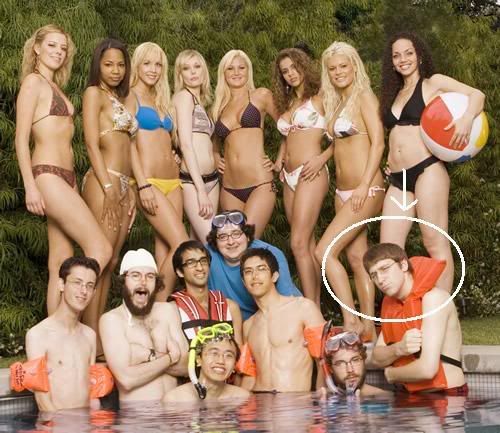
Today was a long day. I walked around the house trying to decide what needs procrastinating and got caught up in Beauty and the Geek, Ashton Kutcher's famous social experiment. I tried, I really did, to hold back my cynicism regarding primetime dating reality shows. But this medium necessitates discussion, cause fucking everybody watches tv way too much. We mindlessly allow someone's ideologies to pander to us, punctuated by fast food and car commercials. Case in point--B and the G. 8 "beauties" were paraded out--a massage therapist, a sorority girl (that was her profession, I guess), the ultimate Hooters girl (she's on the mousepads too, yo), a Playboy centerfold hopeful, a nanny, etc. Then 8 "geeks": robotic engineers, level five dungeon masters, graduate students, physicists, etc. This year there's a twist--a geek chick and a hot dude. This was the best part--all the couples looked over the stairwell as the plot bombshell walked in, up the stairs, slowly. The "beauties" put their hands over their mouths, salivating at the mere thought of a hot dude in the house while the geeks looked on, disgruntled. Lots of reaction shots. Dum dum dummmm....They turned around to face the camera. And here's the dude, wearing a sleeveless shirt, completely douchebag haircut, fake tan, and a look of undeserved accomplishment on his face. I went to go have a cigarette and cuss.
Add a montage complete with reaction shots, embraces, tears, slow-motion, and a pathetically asinine soundtrack and you have yourself a hit tv show which millions of normal people tuning in each week.

People like beauty, I get it. It's no surprise that pretty people get more breaks. I suppose it all evens out when you have your Britneys and Anna Nicoles. There's research that shows newborns favor symmetrical faces. Hotties get hired over not-so-hotties. Not a lot of ugly prom queens. The beautiful people are most usually the rich and the powerful as well. It's human nature. But good genes and luck obviously aren't character traits, you know? It doesn't make you a good person, or better than anyone else. I even understand why such shows have to go to extremes, otherwise it'd just be liking watching a tv version of our own lives, and who wants that?

What bothers me is that the CW and everyone in the biz get to impose stereotypes on the masses, and we blindly accept that this person is a geek and therefore smart and this one is pretty and must be stupid (although that does seem to be the case on this show). They're undermining themselves even as they try to negate said stereotypes. So one chick is smart and necessarily nerd? She could get some nasty extensions and wear too much makeup and get a boob job and be a beauty too, right? I can't wait to hear the shit coming out of the male beauty's mouth. Also, why are there 6 blonds, one black girl, and one Mexican? Just what is beauty? Just curious.

You can be lots of things, you know.

Go here for something else.

Sunday, September 16, 2007

8 Interesting Ideas in Myers

I've been grappling with the task of writing another post about Myers since his book is so jam-packed, so I decided to shift modes and write a decontextualized and succinct (sort of) rehashing of top points, based on my notes rather than the text. This is almost more for my purposes, as each time I rewrite notes I learn and remember it a little more.

1. the effects of tools/technology -- tools expand cognition, "every student must have a full range of tools in order to have the opportunity to be able to generate a full range of thoughts and to have a complete opportunity to show what he or she can do...." (161)

2. Sign shifting leads to new ways of knowing. Every sign system has levels of understanding. See also Bruner's new interpretation of Vgyotsky, Piaget's decalage, and Gardner's Multiple Intelligences.

3. Types of speech events (Hymes) -- notational (memory retrieval, avoids personal agency), academic/ritual (distancing, nominalization, 3rd person), conversational/social (linked to local identity, vernacular, colloquialisms), presentational, multivocal. What are we teaching in schools?

4. National Assessment of Education Progress recognizes 3 types of writing -- informational, persuasion, narrative (where Kinneavy's subcategories of expressive, referential, literary, and persuasive could fall). In Translation/Critical, there are 5 modes -- expressive, narrative, descriptive, expositive, argumentative.

5. The Enlightenment precipitated a shift of methods of knowing from time and space (narrative/descriptive) to parts or fragmentation (exposition/argumentative). Here I see an overlap to the first chapter of Schon's The Reflective Practitioner where he discusses the crisis of confidence in professional knowledge structures as one organization after another falls or fails. Translation/Critical literacy sees a balance, a shift from types of texts to types of readings -- here Harding and Rosenblatt collaborated, in 1938, the same year as John Dewey's Education and Experience came out.

6. The importance of play--"Pretend disarms and enchants; it suggests heroic possibilities for making changes." See Dibs: In Search of Self by Virginia Axline

7. Trans/crit lit. "keeps traditional literacy and pairs with previously marginalized voices, adding other forms, helping students to express themselves, comprehend/appreciate/critize literary texts within the context of other cultural artifacts, encourage a diversity of response." This definition of literacy is organized around apprenticeships and situated in communicative events.

8. There will be and is a struggle of local forms of literacy with the dominant form--parents with analyzing/decoding jobs vs parents whose jobs feature problem-solving and translation/critical type tasks. There will be those who fear a loss of nationhood in this view of literacy, those who fear exclusion in the melting pot.

Monday, September 10, 2007

Piagetian exceptions and inner monologues

One of the many things from Myers that caught my attention is his explanation of the Piagetian letdown. Piaget's theory of development (something we all probably learned in high school psych or at least undergrad ed) has these stages that all kids supposedly go through in the same order, but not at the same rate. It does make sense. This idea was the basis of my training when I worked for the IRD, something I had to constantly repeat during parents' meetings and conferences with not-doing-well students, and it's something I believed, but anytime you say something like "all kids," you're setting yourself up. Piaget described the exceptions as "decalage"--every concept can have several layers or levels of meaning, and this is not the exception, but the rule. Just like AISD's slogan "every child can learn" (duh), these pat ideas and boxes don't contain or explain how children learn, what they learn, and what they learn to do with it. I was really impressed when my kids figured out how to get around the myspace firewall, for appearing to have little technological skill. Unfortunately this kind of problem solving isn't tested on TAKS. As described in Ch. 10, negotiating sign systems, problem solving, and communication is what we should be focusing on in our curriculum. Given the scope of the Internet's effect on how we communicate, learn, think, etc, it's ridiculous that kids are given so little time in the computer lab and are so restricted in their search parameters.

More interestingly, Myers goes on to suggest that we not only condone internal talk (deemed to be sign of craziness by mainstream society), but make it explicit, to use "the power of internalized discourse as a tool for self-regulation, problem analysis, and self-discovery." We all do it. I was thinking a good blog would be one where all one's inner monologue was written down, but I don't think it works that way--some things, once uttered or written, lose the function of its structure. To say your inner thoughts aloud would place them outside the context of your own brain, out there in the world to clash and interact with other stuff. It's not meant to be shared, it's how you work through things on your own, and it's pretty important unless we want classrooms of helpless kids who rely on us for everything.

Chapter 8 is titled "Embodied Knowledge: Self-fashioning and Agency." The idea is that a form of literacy is always a form of self-fashioning. Clearly our self-talk also influences and forms our identity, and it worries me, given the state of things, what kids may be saying to themselves and making of themselves.

More to come.

Tuesday, September 4, 2007

the nature of happiness

As a graduate student in the school of Curriculum and Instruction in the area of Language and Literacy with a Reading Specialist dealie on the end of all that bullshit, one ridiculously abstract thing I've learned is the importance of metacognition. In English, thinking about what you've learned and how you learned it. The ability to read, write, and talk helps this process along. Duh, right?

*gets another drink*

Once upon a time, Mark told me that Tech restricts its students' choice of writing topics in curious ways. The subjects of the war, homosexuality, abortion, sex education, campus parking issues, and (this is the kicker) the "nature of happiness." This is what comes of letting a town be run by fundamentalists and Baptists. It's a dry county too. Of course this kind of oppression can lead to more than deviance and unwed mothers, it can also lead to great acts of creativity and rebellion. I know, I went to college in Iowa. There were nine churches and one bar, and I turned out just fine.

But back to the point--the nature of happiness. Really the baseline desire in any conscious person's heart. What makes us happy? What is happiness? Could a more wildly objective question be asked? Here's what Wikipedia says.

Now go reflect on that.