a blog for class.

Wednesday, March 19, 2008

May 17, Here I Come!

Reprint - As I get closer and closer to graduating from UT with my masters degree, I find myself looking back over the last two years for what sticks out. I read dozens of books, hundreds of articles, brazillions of papers (slightly exaggerating here), participated in many discussions, listened to lectures, took notes, did research, etc, etc, etc. I know how privileged I am to have done this. So I think as far as my own products, the stuff that I wanted to get into and designed myself, I'm most proud of my graffiti project, my blog as a whole, and my research on juvenile correction facility curriculum. Because I've been a bit of a slacker lately as far as writing new stuff, I reprint for you below my graffiti project.

This project is about graffiti. I've been working on it since about the middle of the semester, recognizing early on that graffiti was an exception to the regular rules and theories about literacy, writing, art, and communicating. Despite its power in sending political and social messages, it's a crime. Regardless of what is written, the physical act is defacing "public" property, intellectual shared space set in the widest cultural context possible--people and life. The message has to be short and powerful, in a certain place. I got my pictures from a fantastic website which contains 500 images of graffiti photographed from all over the world, updated weekly. This site is a publishing house/record label type of thing, very cool.
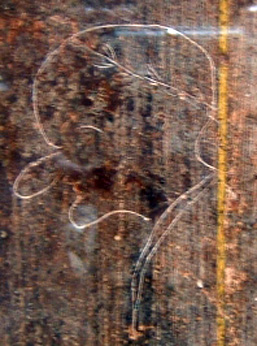

Other thoughts--technically, cave drawings were graffiti.... it has existed since at least ancient Greek times. This is an ancient Pompeiian caricature of a politician. Tell me that doesn't look like Mr. Magoo. Here's an example of some vintage Roman tagging:
Quisquis amat. veniat. Veneri volo frangere costas fustibus et lumbos debilitare deae.
Si potest illa mihi tenerum pertundere pectus
quit ego non possim caput illae frangere fuste?
Whoever loves, go to hell. I want to break Venus's ribs with a club and deform her hips.
If she can break my tender heart
why can't I hit her over the head?
-CIL IV, 1284.


There's graffiti on the Great Wall of China, and on the Coliseum wall ("Suspirium puellarum Celadus thraex: "Celadus the Thracian makes the girls sigh"). It's on Signature Rock along the Oregon Trail, and has continued to evolve. Now closely entwined with hip hop culture, it can be found on subway cars, buildings, walls, bridges, and at the death cites of Princess Di, Biggy, Tupac, Jim Morrison, and many others, as well as in modern art galleries and museums. A portion of graffiti is considering tagging, known for its gangsta influence and territorial nature--taggers go by nicknames and have unique styles.

For these reasons and public fear of vandalism and high crime rates, penalties for public defacing are stiff. You might remember Michael Fay, the kid who got caned in Singapore in 1994. He got caught tagging. Here in the states, Giuliani and Daley passed laws in the early nineties as part of their Anti-Graffiti Task Force (NY) and Graffiti Blasters (Chicago) that resulted in $350 fines, regulations as to the locked-upness of spray paint in stores, and speedy graffiti removal when phoned in. But like all forms of expression when repressed by government, it continues to speak. Loudly.

Here's what I wanted to accomplish with this project:
1) To show how the messages evoke a particular emotion, a triggered memory, a communal agreement/disagreement, humor, sadness, self-reflection, etc.
2) To pay attention to the materials used--paint, props, scenery, etc, and notice how they are part of the message
3) To examine graffiti as both social action and art.
4) To explore the themes in graffiti messages I saw repeated with little variation--love/heartbreak, anger/revenge, anarchy/politics, religion/living, pop culture/materialism.

There were a lot of considerations in making this movie, my first. First, learning how to use Windows Movie Maker, importing sorted pictures, setting the timing, choosing the accompanying music, etc. Especially after our last class meeting when semiotics was discussed, there was a feeling of interconnectedness through all these decisions, and I realized making movies was harder than just yelling "cut!" and "print!" and dealing with movie stars. Each independent element is a sign--I didn't want the music to change or offer interpretation to the messages, but I wanted it to somehow fit the discordant moods that would result from viewing themed messages. I had originally used "Psychobabble" by Frou Frou, as the timing of the beats fit well with the slide transitions, but the words imposed a coherent mood that couldn't contain the rampant emotional changes from viewing the message. I settled on a classical piece by Philip Glass which was in the movie The Hours, from a particular scene that featured walking down the streets of NYC, where there is a huge graffiti movement. I also wanted some slides to be held longer than others for reflection. I didn't arrange them in any order within their categories, which were love/heartbreak, religion/living, politics/anarchy, anger/revenge, materialism/pop culture, and (part two) those that incorporated the physicality of the surface or tool in the message itself. I chose to use my blog to explain all this, as I can include even more pictures and ideas than I could in a traditional paper.

Here 'tis, please enjoy (turn off my playlist first):

Tuesday, March 18, 2008

The Souls of Black Folk, by W.E.B. Du Bois: A Review


for my cultural theory in education class. will be back with regular posting jibber-jabber soon.

The way W.E.B. Du Bois writes is amazingly eloquent and rich while deeply intelligent and thoughtful. The back cover of his book (which you can read in full here) describes it as essential reading for everyone interested in African-American history and the struggle for civil rights in America, which excludes no one. Though most of us claim to be racism-free, I see traces of prejudiced legacy running through us that I do not wish to have and seek to eradicate but really do not understand. Some of the ideas that really stood out to me were the economic factors of the post-Civil War South, the influence of the New England schoolmarm, the true aims of education, race relations, and the question of the future and how we are going to get along in it.

At first I somehow missed the fact that TSoBF was first published in 1903, and wondered what Du Bois would say of today’s world and race relations. It seems like some of the race issues and what was going on in “black folks’ souls” have not changed drastically today, which perhaps is why I forgot it was written over a hundred years ago. I think our main problem today is still the color line. The legacy of the Freedmans’ Bureau (lawlessness and crime, page 24) continues to haunt the black image today, and the demoralizing camp life of the days following the Emancipation sound like a form of early ghettoism. Du Bois highlights for me some of the reasons why racism and prejudice against blacks remains so deep-seated and implacable even now in the 21st century, a sad state of affairs to say the least. Right from the beginning of the book, he clarifies the problems of poverty, bastardy (at the hands of white slave owners and lechers beyond 1865), the ballot and the school, and how “Negroes” (a term I have trouble using for obvious reasons in this day and age) had an abundance of the former and a serious deficit in equality of the latter. My white guilt cast a shadow over the pages as I read, wanting to weep for the injustices of the past, probably at the hands of my own ancestors. Nevertheless, the accomplishment of the Freedmans’ Bureau were impressive, mostly noticeably in the establishment of schools and enlisting help for the newly freed. I wondered briefly if any former slaves regretted their new-found liberty once the economic and legal oppression became even more starkly outlined as they attempted to live their lives (this thought resurfaced around pg. 110 as the author describes the daily life of the house servants, their intimacy and family ties with the family, and the consequences of the coming separation and class-forming of post-1865 life). What exactly is freedom, anyway?

“It is a hard thing to live haunted by the ghost of an untrue dream; to see the wide vision of empire fade into real ashes and dirt; to feel the pang of the conquered, and yet know that with all the Bad that fell on one black day something was vanquished that deserved to live, something killed that in justice had not dared to die; to know that with the Right that triumphed, triumphed something of Wrong…All this is bitter hard, and many a man and city and people have found in it excuse for sulking, and brooding, and listless waiting.” (48)

Du Bois is remarkable in that he draws his own life into his words but does not make the story about him. He cites politics through prose, and researches people to understand history, yet he does not demand specific actions, anarchy, or attitudes in response, nor does he attempt to justify or apologize for the past or present. He quietly asks through reason and passion for a revolution starting in the mind and the opening of it.

Another topic that Du Bois explores is the role of the New England schoolmarm—in the wake of national upheaval, these brave teachers educated a generation of ignorant people struggling to meet the outrageous demands of their new world. That image of the alphabet ringing out across the scorched fields will always stick with me. This made me feel a little better about myself, as I was a teacher myself, to know how important and vital the role of the educator was and is.

“To make here in human education that ever necessary combination of the permanent and the contingent—of the ideal and the practical in workable equilibrium—has been there, as it ever must be in every age and place, a matter of infinite experiment and frequent mistakes.” (57) Certainly this has bearing on our current situation of experimenting and mistake-making in educational policy-making and the state of public schools. More importantly, Du Bois stresses the true aim of education (and the real potential for learning) is through the interaction of human spirits, “the contact of living souls” (63), the developing of human reason, the sharing of stories and emphasis on the positive aspirations of mankind—certainly this should be our focus too as we educate children in today’s world of war, inequity, and prejudice.

Other chapters as Du Bois travels through post-war Georgia and comments on the lives and politics there reminded me of Gone with the Wind—a favorite book of mine since childhood, and a film I would watch with my mom whenever it was on TV. Romanced by the antebellum costumes and mansions and whatnot but somewhat ignorant as to the racial turbulence as a child, it was eye-opening to understand what was going on for black folk during this time. Margaret Mitchell presents a fairly accurate portrayal of the old South, garnered from conversations on porches with older folk who had lived through it, but older white folk. Another powerful book from this time period includes Roll of Thunder, Hear My Cry, told from the viewpoint of a young black girl in the rural South who watches her family struggle to keep their land as she herself experiences prejudice and racism at school and in town (two powerful social concepts Du Bois studies).

Another well-expressed concept is Du Bois’ approaches to studying race relations. Citing physical proximity, economic and political factors, intellectual contact and commerce, forms of everyday social contact, and religious enterprise as the six elements of race relations, he teases apart what this really means for a turn-of-the-century black American. Here again I hear echoes of 21st century American turmoil—the alignment of locations of homes to economic status allow for the worst of both races to see each other. There was some serious and illegal screwing-over of voiceless minorities, which we see today as well. Political activity, both then and now, seems to do little to seriously help blacks, or really anyone who was not white and rich. “So flagrant became the political scandals that reputable men began to leave politics alone, and politics consequently became disreputable.” (105) As Du Bois says on the next page, there is no way of telling how much one will be taxed, how the taxes are used, who makes such laws and how, who enforces them and how, etc. In 105 years, is that so far gone from our current system of government? The same can be said for the reasons and perspectives Du Bois cites for increases in black crime and the consequences of creating a jail culture in a seriously inequitable class society. We see similarities again in school funding along racial lines, now and then. In 1903, the author called for “a union of intelligence and sympathy” as the only real way to preserve the justice of the Republic—two things I unfortunately do not believe enough Americans possess in great quantities.

Du Bois turns from politics and economics in his last chapters on religion (The Preacher, The Music, and the Frenzy), the joyous birth and tragic death of his infant son, Alexander Crummell, the sorrow songs, and the confusions of John Jones as he attempts to make sense of the North, South, and subordination, eventually becoming a teacher. This conversation summed up my final thoughts best:

“John,” she said, “does it make everyone—unhappy when they study and learn lots of things?”
He paused and smiled. “I am afraid it does,” he said.
“And, John, are you glad you studied?”
“Yes,” came the answer, slowly but positively. (149)

Saturday, March 8, 2008

The Mosquito


About a month ago, I heard about this invention called The Mosquito on the BBC (which I listen to in the morning to make myself feel like a grownup). Designed to repel the hoodies of London, it emits a high frequency squeal which the ears of the young alone can hear. I made a mental note to write about this ridiculousness and then laziness set in, so I had to convince myself that it wasn't that good of a post idea. Then it was on the local news tonight, so I had to take it as a sign. However, that's really all I have to say about it. The Mosquito. What asshole kid-haters came up with this? I guess I can understand wishing to be rid of obnoxious adolescent customer-frighteners, but is treating them like animals the way to do it? Kids, if you haven't noticed, are both dumb and smart at the same time. The common sense that comes with experience hasn't manifested itself yet, so they say ridiculous things like "I wanna get married when I'm 18 and have 5 babies but I don't wanna go to college or have a job." You were a kid once. Didn't you think dumb things too? I know I did. But that's another post.

What kids do have is a much firmer grip on the influx of technology and new media, whereas older folks grapple to multi-task between the cell, Internet, their inhalers, GPS, PDAs, canes, car keys, pagers, Ipods, and dentures. Yet it's harder for a rich person to get into heaven than it is for an informed educator working from a socio-constructive framework to get permission to show a film in their language arts class. Behold, the myth of effective education being fun holds sway. Talking must be naughtiness. They must sit in their desks and take multiple-choice tests and be graded and ranked like so many freshly slaughtered pounds of beef.

Ahem. Sorry. I am working on a lit review of using film as a pedagogical tool, and am still bitter about not being allowed to show Roots in my class a few years ago (I did anyway, so eat a turd, Principal), despite my arduous linking to TAKS objectives.

Getting back to the mosquito, I am prepared to award a mysterious prize to someone who can give me the best way to use the Mosquito for evil and not good (depending on where you stand). A few British kids already figured out how to make it into an adult-proof ringtone. How can we use this insulting device to further turn the tide in the anarchist's favor? And for those of you who insist kids are awful and evil (although I agree with you from time to time), let me remind you that it starts like this:


but it comes from watching adults do this:


If I have not convinced you that the Mosquito is stupid and will only serve to widen the gap between authority and those struggling against it in search of their own, you can buy one here.

Tuesday, March 4, 2008

Picturas

A hippie with bright pink hair let me hold her pit puppy at Maria's Sunday morning. His name is Rowan, and he made my heart fluttery when he licked my face and nipped my fingers. The others are from Bull Creek where I've been hiking nearly everyday. Sorry for the poor quality, they're with my cell camera. I've yet to convince someone to buy me a new digital. Donations are welcome.


Photobucket - Video and Image Hosting


Photobucket - Video and Image Hosting


Photobucket - Video and Image Hosting


Photobucket - Video and Image Hosting


Photobucket - Video and Image Hosting


What else? My horoscope, that's what: Cary Grant said he didn't necessarily advocate making love constantly. "Who can do it all the time?" he asked. "Though I do try." Your assignment in the coming weeks, Scorpio, as revealed by the astrological omens, is to attempt what Grant aspired to do: Do the wild thing as much as possible. Get busy before breakfast on the kitchen table and on your midmorning break in the closet. Duck out of work early so you can get your freak on. Get a hundred more strokes and licks and kisses in before bedtime. Et cetera. And if you don't have a lover to help you out in the noble cause, then boink the wind, screw the sky, hump your dreams, make love to the universe.

That's an astrological assignment I can get behind.