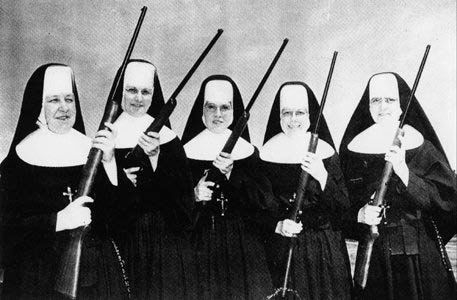
the mantra of reality television...
Speaking of reality tv, I'm watching the finale of Hell's Kitchen right now, and I have to admit I'm a bit disappointed Petrozza didn't win. I'm not a regular watcher per se, but I know enough about it to doubt that Kristina, who just graduated, can run a restaurant. I wanted LouRoss to win anyway, but the whole show is so ridiculous and profanity-laden. Kristina's camera confession scene (which came after a dizzying array of suspense-building camera shots for about 45 seconds and a commercial break) consisted of screaming "HOLY FUCKING SHIT!!!" I have to wonder--don't these people realize their grandmas and childhood friends and pastors' wives see all this? I cuss like a sailor, but I try not to be filmed on national television doing it.
Speaking of not making friends, I must vent for just a minute--I've been taking Krav Maga for the last couple weeks, and most of the time I love it. If you haven't heard of it, it's Israeli combat/self-defense. It kicks my ass, my muscles burn, and I leave with my hair soaked and feeling like an old lady. But a tough old lady. Today, I had to pair up with this dykeadelic chick who was, to her credit, a badass. She was however uncoordinated as all hell, and tried to blame my punching for it. I was "doing something weird." Uh huh. I admit I don't always give 100% and I joke around some, but I do work hard. So anyway, we're learning defensive moves and blocks tonight, and she starts blocking my punches with more force than I'm punching with--the point is to defend, you don't have to do it really hard. Plus this is a beginner class. It's essentially non-contact, but sometimes we kinda get physical. So anyway, my forearms are getting bruised like peaches but she doesn't give a shit. Then--she hit me in the face. We were adding combination moves and were supposed to be giving it like 50%--not full on war. I'm tough too, so it wasn't a big deal. Then she did it again. No apology, no oops. The third time she popped me right in the mouth, and I stepped up, towering over her, and said quietly, "Do that again and I'll hit you back. A lot harder." Her sweaty pale face with its set expression of rarrrr fell. I stepped back and put my hands up, ready, but she just stood there. I could see she had been rattled, unnerved. The instructor called us together, gave us a few last tips, and dismissed us, and Blondie hightailed it out of there like her ass was on fire. I resisted the temptation to yell after her, "Yeah you better run, you little bitch!"
Showing posts with label intelligence. Show all posts
Showing posts with label intelligence. Show all posts
Tuesday, July 8, 2008

Sunday, September 16, 2007
8 Interesting Ideas in Myers
I've been grappling with the task of writing another post about Myers since his book is so jam-packed, so I decided to shift modes and write a decontextualized and succinct (sort of) rehashing of top points, based on my notes rather than the text. This is almost more for my purposes, as each time I rewrite notes I learn and remember it a little more.
1. the effects of tools/technology -- tools expand cognition, "every student must have a full range of tools in order to have the opportunity to be able to generate a full range of thoughts and to have a complete opportunity to show what he or she can do...." (161)
2. Sign shifting leads to new ways of knowing. Every sign system has levels of understanding. See also Bruner's new interpretation of Vgyotsky, Piaget's decalage, and Gardner's Multiple Intelligences.
3. Types of speech events (Hymes) -- notational (memory retrieval, avoids personal agency), academic/ritual (distancing, nominalization, 3rd person), conversational/social (linked to local identity, vernacular, colloquialisms), presentational, multivocal. What are we teaching in schools?
4. National Assessment of Education Progress recognizes 3 types of writing -- informational, persuasion, narrative (where Kinneavy's subcategories of expressive, referential, literary, and persuasive could fall). In Translation/Critical, there are 5 modes -- expressive, narrative, descriptive, expositive, argumentative.
5. The Enlightenment precipitated a shift of methods of knowing from time and space (narrative/descriptive) to parts or fragmentation (exposition/argumentative). Here I see an overlap to the first chapter of Schon's The Reflective Practitioner where he discusses the crisis of confidence in professional knowledge structures as one organization after another falls or fails. Translation/Critical literacy sees a balance, a shift from types of texts to types of readings -- here Harding and Rosenblatt collaborated, in 1938, the same year as John Dewey's Education and Experience came out.
6. The importance of play--"Pretend disarms and enchants; it suggests heroic possibilities for making changes." See Dibs: In Search of Self by Virginia Axline
7. Trans/crit lit. "keeps traditional literacy and pairs with previously marginalized voices, adding other forms, helping students to express themselves, comprehend/appreciate/critize literary texts within the context of other cultural artifacts, encourage a diversity of response." This definition of literacy is organized around apprenticeships and situated in communicative events.
8. There will be and is a struggle of local forms of literacy with the dominant form--parents with analyzing/decoding jobs vs parents whose jobs feature problem-solving and translation/critical type tasks. There will be those who fear a loss of nationhood in this view of literacy, those who fear exclusion in the melting pot.
Subscribe to:
Posts (Atom)