Sunday, April 29, 2007

Thursday, April 26, 2007
"pure mind-stuff"

I realized lately how much our perceptions of writing, creating, connecting, etc, centered around the internet, and how they've changed, and how screwed we'd be if it shut down somehow. As I write this, my brain is working out ways to incorporate more information in various formats (pics, links, tags, vids) to make for a better blog. I've become obsessed with del.icio.us and don't know what I'd do without texting (I have unlimited texts with tmobile for $15 a month) and blogging. When encountering an unfamiliar reference, I've got Wiki on my drop-down. But I didn't know about all the cool stuff that you can do as Rheingold describes in Smart Mobs, and now I'm a little scared. I thought the cell phones that pinpoint your location were a
 little creepy. I hear you can also put a thing in your kid's car and track them around town like a damn dolphin. I recently received a text from a random number on April 20 encouraging me to celebrate 420. There's no doubt our tech-savvy is bursting with usefulness at the sacrifice of privacy. I actually feel a little sorry for Alec Baldwin these days, after his voicemail ranting became public property. Seems like we could do something about malaria in third world countries before perfecting real life gaydar, celebrity stalker alerts, and dating services that beep you when a potential mate is within striking distance.
It also seems the availability plus the instantaneousness (yes that's a word, I just created it) plus the sheer volume of information in our world is going to require a lot more discernment on the part of the sheep, I mean, people.
These words will be worth remembering when millions of people carry devices that invisibly probe and cloak, reach out, evaluate, interconnect, negotiate, exchange, and coordinate invisible acts of ad hoc cooperation that create wealth, democracy, education, surveillance, and weaponry from pure mind-stuff, the way the alchemy of inscribing ever-tinier patterns on purified sand invokes the same forces from the same place."
The discussion about threshold models of collection action and emergent behavior was also interesting--I used to talk to my 7th graders about the difference between a crowd and a mob before reading "The Monsters are Due on Maple Street." "Decades ago, computer scientists thought that someday there would be forms of 'artificial intelligence' ...they never thought in terms of computer-equipped humans as a kind of social intelligence." This certainly holds a lot of promise for anarchists and revolutionaries, all in their Palm Pilot.
Click here to read a fantastic online chat between a guy named Remy and Dell Customer Service. You won't regret it.
Query (especially for writing teachers)--is the pen mightier than the sword?
Simpsons episode about WOW
Sunday, April 22, 2007
more of the same
I couldn't help but think about the maniac at V Tech as I read through the mountain of text for this week. It was inescapable as I waded into the part about social skills being part of the New Media Consortium's 21st century literacy, and participatory cultures. Earlier this afternoon, unable to fight off morbid curiosity, I watched the media package he sent to NBC the morning of the shootings--pictures of himself (many of them with guns), short clips of him talking crazy into the camera about random life problems, etc. I heard over the weekend that Nikki Giovanni is a prof at V Tech, and wouldn't allow the psycho into her class. Like those other kids who shot up their schools, this kid had been tormented and picked on all his life. In no way does past bullying justify the massacre of dozens of people, but it got me thinking about how many hurting kids are relying on public schools to teach them how to live and cope and communicate, and how they're falling short.
I was tempted to link Cho's video but didn't, to make a point. I will say that youtube has some interesting video responses, 2 cents, and personal stories to share about V Tech.
"Corporate cultures and their discourses of familiarity are frequently more subtly and more rigorously exclusive than the most nasty - honestly nasty - of hierarchies. Replication of corporate culture demands assimilation to mainstream norms, and this really works only if a person already speaks the language of the mainstream...these new workplace discourses can be taken in two very different ways - as opening new educational and social possibilities, or as new systems of mind control of exploitation...market-directed theories and practices, even though they sound humane, will never authentically include a vision of meaningful success for all students." (New London Group)
Most schools haven't really changed dramatically in a general sense, kids and their situations have. You can't keep teaching the same way for fifty years and expect the same results. I feel like the grading/testing/ranking effects of mass public school hurts us overall, as does the small box it forces everyone into. And I'm not saying that in a "no more teachers, no more books" kinda way, I'm taking into consideration what I've read about authentic assessments versus standardized testing, the psychology of learning, multicultural curriculum, arts-integrated curriculum, the plethora of stupid rules in place, the micromanaging of teachers, etc. I think it's kinda funny in a sad way that the New London Group article claims the most important skill students need to learn is to negotiate regional, ethnic, or class-based dialects, when in real life it seems like learning the white middle-class way to do, say, and think things is really what we're after. For the most part, attempts to validate and even respect other cultures or styles of expression are met with polite tolerance at best and fear/avoidance/persecution at worst.
"Schools regulate access to orders of discourse...the role of pedagogy is to develop an epistemology of pluralism that provides access without people having to erase or leave behind different subjectivities." (NLG) Yet we base nearly everything on a multiple-choice test. I still have nothing but admiration for teachers, but I won't be going back to the classroom myself until there are significant changes and a new administration. I appreciate the changes that some brave teachers and faithful districts are trying, using the new skills of our 21st literacy. But in real life, teachers lose their jobs if they don't do what districts and superintendents tell them to do, even if it's in the best interest of their kids, and it's the same at the administrative level and above. There are future educators who need jobs too. We need a change up at the top, someone who will follow through with what has shown to be successful.
I was tempted to link Cho's video but didn't, to make a point. I will say that youtube has some interesting video responses, 2 cents, and personal stories to share about V Tech.
"Corporate cultures and their discourses of familiarity are frequently more subtly and more rigorously exclusive than the most nasty - honestly nasty - of hierarchies. Replication of corporate culture demands assimilation to mainstream norms, and this really works only if a person already speaks the language of the mainstream...these new workplace discourses can be taken in two very different ways - as opening new educational and social possibilities, or as new systems of mind control of exploitation...market-directed theories and practices, even though they sound humane, will never authentically include a vision of meaningful success for all students." (New London Group)
Most schools haven't really changed dramatically in a general sense, kids and their situations have. You can't keep teaching the same way for fifty years and expect the same results. I feel like the grading/testing/ranking effects of mass public school hurts us overall, as does the small box it forces everyone into. And I'm not saying that in a "no more teachers, no more books" kinda way, I'm taking into consideration what I've read about authentic assessments versus standardized testing, the psychology of learning, multicultural curriculum, arts-integrated curriculum, the plethora of stupid rules in place, the micromanaging of teachers, etc. I think it's kinda funny in a sad way that the New London Group article claims the most important skill students need to learn is to negotiate regional, ethnic, or class-based dialects, when in real life it seems like learning the white middle-class way to do, say, and think things is really what we're after. For the most part, attempts to validate and even respect other cultures or styles of expression are met with polite tolerance at best and fear/avoidance/persecution at worst.
"Schools regulate access to orders of discourse...the role of pedagogy is to develop an epistemology of pluralism that provides access without people having to erase or leave behind different subjectivities." (NLG) Yet we base nearly everything on a multiple-choice test. I still have nothing but admiration for teachers, but I won't be going back to the classroom myself until there are significant changes and a new administration. I appreciate the changes that some brave teachers and faithful districts are trying, using the new skills of our 21st literacy. But in real life, teachers lose their jobs if they don't do what districts and superintendents tell them to do, even if it's in the best interest of their kids, and it's the same at the administrative level and above. There are future educators who need jobs too. We need a change up at the top, someone who will follow through with what has shown to be successful.
Wednesday, April 18, 2007
this is my project
This project is about graffiti. I've been working on it since about the middle of the semester, recognizing early on that graffiti was an exception to the regular rules and theories about literacy, writing, art, and communicating. Despite its power in sending political and social messages, it's a crime. Regardless of what is written, the physical act is defacing "public" property, intellectual shared space set in the widest cultural context possible--people and life. The message has to be short and powerful, in a certain place. I got my pictures from a fantastic website which contains 500 images of graffiti photographed from all over the world, updated weekly. This site is a publishing house/record label type of thing, very cool.
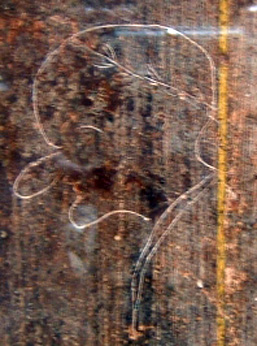
Other thoughts--technically, cave drawings were graffiti.... it has existed since at least ancient Greek times. This is an ancient Pompeiian caricature of a politician. Tell me that doesn't look like Mr. Magoo. Here's an example of some vintage Roman tagging:
There's graffiti on the Great Wall of China, and on the Coliseum wall ("Suspirium puellarum Celadus thraex: "Celadus the Thracian makes the girls sigh"). It's on Signature Rock along the Oregon Trail, and has continued to evolve. Now closely entwined with hip hop culture, it can be found on subway cars, buildings, walls, bridges, and at the death cites of Princess Di, Biggy, Tupac, Jim Morrison, and many others, as well as in modern art galleries and museums. A portion of graffiti is considering tagging, known for its gangsta influence and territorial nature--taggers go by nicknames and have unique styles.
For these reasons and public fear of vandalism and high crime rates, penalties for public defacing are stiff. You might remember Michael Fay, the kid who got caned in Singapore in 1994. He got caught tagging. Here in the states, Giuliani and Daley passed laws in the early nineties as part of their Anti-Graffiti Task Force (NY) and Graffiti Blasters (Chicago) that resulted in $350 fines, regulations as to the locked-upness of spray paint in stores, and speedy graffiti removal when phoned in. But like all forms of expression when repressed by government, it continues to speak. Loudly.
Here's what I wanted to accomplish with this project:
1) To show how the messages evoke a particular emotion, a triggered memory, a communal agreement/disagreement, humor, sadness, self-reflection, etc.
2) To pay attention to the materials used--paint, props, scenery, etc, and notice how they are part of the message
3) To examine graffiti as both social action and art.
4) To explore the themes in graffiti messages I saw repeated with little variation--love/heartbreak, anger/revenge, anarchy/politics, religion/living, pop culture/materialism.
There were a lot of considerations in making this movie, my first. First, learning how to use Windows Movie Maker, importing sorted pictures, setting the timing, choosing the accompanying music, etc. Especially after our last class meeting when semiotics was discussed, there was a feeling of interconnectedness through all these decisions, and I realized making movies was harder than just yelling "cut!" and "print!" and dealing with movie stars. Each independent element is a sign--I didn't want the music to change or offer interpretation to the messages, but I wanted it to somehow fit the discordant moods that would result from viewing themed messages. I had originally used "Psychobabble" by Frou Frou, as the timing of the beats fit well with the slide transitions, but the words imposed a coherent mood that couldn't contain the rampant emotional changes from viewing the message. I settled on a classical piece by Philip Glass which was in the movie The Hours, from a particular scene that featured walking down the streets of NYC, where there is a huge graffiti movement. I also wanted some slides to be held longer than others for reflection. I didn't arrange them in any order within their categories, which were love/heartbreak, religion/living, politics/anarchy, anger/revenge, materialism/pop culture, and (part two) those that incorporated the physicality of the surface or tool in the message itself. I chose to use my blog to explain all this, as I can include even more pictures and ideas than I could in a traditional paper.
That said, here are a few cool videos about graffiti.
A graffiti machine--Robofiti
These guys draw on the sides of huge buildings with lasers...amazing
Taggers get a train before security gets them.
My video is almost done, will post it asap.
Other thoughts--technically, cave drawings were graffiti.... it has existed since at least ancient Greek times. This is an ancient Pompeiian caricature of a politician. Tell me that doesn't look like Mr. Magoo. Here's an example of some vintage Roman tagging:
- Quisquis amat. veniat. Veneri volo frangere costas fustibus et lumbos debilitare deae.
- Si potest illa mihi tenerum pertundere pectus
- quit ego non possim caput illae frangere fuste?
- Whoever loves, go to hell. I want to break Venus's ribs with a club and deform her hips.
- If she can break my tender heart
- why can't I hit her over the head?
- -CIL IV, 1284.
There's graffiti on the Great Wall of China, and on the Coliseum wall ("Suspirium puellarum Celadus thraex: "Celadus the Thracian makes the girls sigh"). It's on Signature Rock along the Oregon Trail, and has continued to evolve. Now closely entwined with hip hop culture, it can be found on subway cars, buildings, walls, bridges, and at the death cites of Princess Di, Biggy, Tupac, Jim Morrison, and many others, as well as in modern art galleries and museums. A portion of graffiti is considering tagging, known for its gangsta influence and territorial nature--taggers go by nicknames and have unique styles.
For these reasons and public fear of vandalism and high crime rates, penalties for public defacing are stiff. You might remember Michael Fay, the kid who got caned in Singapore in 1994. He got caught tagging. Here in the states, Giuliani and Daley passed laws in the early nineties as part of their Anti-Graffiti Task Force (NY) and Graffiti Blasters (Chicago) that resulted in $350 fines, regulations as to the locked-upness of spray paint in stores, and speedy graffiti removal when phoned in. But like all forms of expression when repressed by government, it continues to speak. Loudly.
Here's what I wanted to accomplish with this project:
1) To show how the messages evoke a particular emotion, a triggered memory, a communal agreement/disagreement, humor, sadness, self-reflection, etc.
2) To pay attention to the materials used--paint, props, scenery, etc, and notice how they are part of the message
3) To examine graffiti as both social action and art.
4) To explore the themes in graffiti messages I saw repeated with little variation--love/heartbreak, anger/revenge, anarchy/politics, religion/living, pop culture/materialism.
There were a lot of considerations in making this movie, my first. First, learning how to use Windows Movie Maker, importing sorted pictures, setting the timing, choosing the accompanying music, etc. Especially after our last class meeting when semiotics was discussed, there was a feeling of interconnectedness through all these decisions, and I realized making movies was harder than just yelling "cut!" and "print!" and dealing with movie stars. Each independent element is a sign--I didn't want the music to change or offer interpretation to the messages, but I wanted it to somehow fit the discordant moods that would result from viewing themed messages. I had originally used "Psychobabble" by Frou Frou, as the timing of the beats fit well with the slide transitions, but the words imposed a coherent mood that couldn't contain the rampant emotional changes from viewing the message. I settled on a classical piece by Philip Glass which was in the movie The Hours, from a particular scene that featured walking down the streets of NYC, where there is a huge graffiti movement. I also wanted some slides to be held longer than others for reflection. I didn't arrange them in any order within their categories, which were love/heartbreak, religion/living, politics/anarchy, anger/revenge, materialism/pop culture, and (part two) those that incorporated the physicality of the surface or tool in the message itself. I chose to use my blog to explain all this, as I can include even more pictures and ideas than I could in a traditional paper.
That said, here are a few cool videos about graffiti.
A graffiti machine--Robofiti
These guys draw on the sides of huge buildings with lasers...amazing
Taggers get a train before security gets them.
My video is almost done, will post it asap.
Saturday, April 14, 2007
Sign, sign, everywhere a sign. blockin out the scenery, breakin my mind.
I am having a hard time reading Faigley's website, because it's a website. Too much textbooky type stuff to read and scroll through on a screen, although the pictures are nice. As portable as laptops are, I cannot underline things, flip to see how many pages I have left to read, or jot notes in the margin. It's interesting stuff, but it's not getting through to me as clearly as a neatly stapled packet. Anyone else? I guess the materiality does matter...

non-sequitur:


I'll give you a moment to find your brain-sanitizer and acknowledge that reality is not as fun as the high-gloss air-brushed world we are continually fed.
Speaking of which, the internet is apparently at risk of being clean-slated. See the newest link to your right for more details. I wonder if this is a step forward in the Digital Age or a step back. We evolve all the time. Just this morning I found this website, so who needs TV, really?
Art in its various forms has been weighing heavily on my mind lately, between frequent discussions of Grindhouse, watching Entourage, trying to re-form my poetry habit, somehow getting signed up for the four posters-a-month club, and just trying to express myself in a way that is both effective and stylistically me. I wish I could paint or draw or do something artistic, although writing is definitely an art form as well, and I can make decent things out of clay...I'm working on a video for my final project about art in the form of graffiti. It's interesting to me because it's the only writing I can think of (besides slander I guess) that's automatically a crime. Berger's quote about the loss of authority over art that came with the means of reproduction reminded me of graffiti: "For the first time ever, images of art have become ephemeral, ubiquitous, insubstantial, available, valueless, free. They surround us in the same way as a language surrounds us. They have entered the mainstream of life over which they no longer, in themselves, have power." Aside from wanna-be gangsta tagging, the words themselves along with the surface they were painted, etched, or carved on create a meaning that's bigger and stronger than most textbooks I read. The message is short and powerful, sometimes incorrectly spelled, but contextualized in life. We all live the context, and I found that most of the messages in graffiti (found on this website and taken from all over the world) dealt with themes of love, politics, religion, the economy, etc...
non-sequitur:
In addition, Literacy in American Lives contains a chapter about the nature of early writing as secretive, rebellious. I think about notes passed back in forth in class, from my own schooldays. I once wrote the naughtiest words I knew on a chalkboard in the church basement (I don't know exactly why), knowing they'd be discovered and I'd probably go to hell for it.
I was excited to see that Faigley included information about Adbusters, I've used that site in conjunction with teaching a media awareness unit with high school kids. Other than the nonstop stupidity charade that is our current governmental regime, the hyper-consumerism of this country makes me itchy in unmentionable places. I always thought I could do well in advertising but never pursued it for the same reason I'm not a smarmy lawyer (not that all lawyers are bad, some of my best friends are lawyers): I don't think it's right to intentionally manipulate people and words, and people/words are obviously easily manipulated. Here's a few more pictures they didn't include:


I'll give you a moment to find your brain-sanitizer and acknowledge that reality is not as fun as the high-gloss air-brushed world we are continually fed.
Given what Siegel's article says about multimodality transformations and literacy, it makes sense that this is where we're at: we're a bunch of sign-reading mofos.
Monday, April 9, 2007
What it feels like to get robbed.
The cats, who don't exactly see eye to eye, were sitting near each other, looking up expectantly rather than sleeping when I came in from an 11 hour shift at the Alamo on Saturday night. This was A. B was that my laptop was missing from its usual place on my coffeetable. C, the sliding glass door was open about six inches. Whirling around to my bedroom, sure enough--the cash from my last two nights of non-stop Grindhouse table-waiting action was gone from its hidey hole, which isn't too terribly hidey, it seems. I think I called Adam first, asking if perhaps he was playing some weird practical joke on me a week late, but I knew we had been robbed. Probably someone who had been in our house before, at a party maybe, friend of a friend, or someone who knew I was a waittress and would have cash in the house. Jerry's Ipod and Xbox were also taken.
I've been lucky throughout the years--nearly all my friends have had their cars broken into, a few had the whole damn thing stolen. I rarely lock my cars doors. I'm a trusting and somewhat irresponsible person, what do you want me to say? But the relatedness of this story to class is what I went through today to get set up with a new computer. Encompassing various themes discussed so far like technology, rules of communication, ownership, learning, structure, etc, I've haven't felt as dumb as I did today in a long time. Between my special man friend and the poor computer store dude (whom I know on a personal basis now, as this is my third trip to Discount Electronics in the past year, seeing as how my first laptop broke when it was dropped and the second was stolen) and various other formal and informal tech support personnel, I just couldn't speak the damn language. I was familiar with various techy words such as "driver," "networking," "product key," etc, but because I don't understand the underlying structure of the internet, Windows, or anything else, these words don't mean anything. It's like saying "purple" is "monkey." I felt like I was two years old, which is weird because I don't think that two year olds are aware of their two-year-oldness. I know I could learn, but I really don't want to. Seems like there's always a computer nerd around, God blessum.
I need a vacation.
Luckily I have great friends, who let me stay at their place because I don't want to stay at the house, and who bring by a nice bottle of wine or gives me a hug to let me know they feel for me. I don't want to make it sound like my baby died or something, it's just stuff. But knowing that a creepy person was in my house, in my room, saw my pictures, saw my clothes and touched my stuff, that's just a bad, creepy feeling.
Hope everyone had a better Easter than I did.
I've been lucky throughout the years--nearly all my friends have had their cars broken into, a few had the whole damn thing stolen. I rarely lock my cars doors. I'm a trusting and somewhat irresponsible person, what do you want me to say? But the relatedness of this story to class is what I went through today to get set up with a new computer. Encompassing various themes discussed so far like technology, rules of communication, ownership, learning, structure, etc, I've haven't felt as dumb as I did today in a long time. Between my special man friend and the poor computer store dude (whom I know on a personal basis now, as this is my third trip to Discount Electronics in the past year, seeing as how my first laptop broke when it was dropped and the second was stolen) and various other formal and informal tech support personnel, I just couldn't speak the damn language. I was familiar with various techy words such as "driver," "networking," "product key," etc, but because I don't understand the underlying structure of the internet, Windows, or anything else, these words don't mean anything. It's like saying "purple" is "monkey." I felt like I was two years old, which is weird because I don't think that two year olds are aware of their two-year-oldness. I know I could learn, but I really don't want to. Seems like there's always a computer nerd around, God blessum.
I need a vacation.
Luckily I have great friends, who let me stay at their place because I don't want to stay at the house, and who bring by a nice bottle of wine or gives me a hug to let me know they feel for me. I don't want to make it sound like my baby died or something, it's just stuff. But knowing that a creepy person was in my house, in my room, saw my pictures, saw my clothes and touched my stuff, that's just a bad, creepy feeling.
Hope everyone had a better Easter than I did.
Subscribe to:
Posts (Atom)