I don't really have internet anymore. I could surf at work but I don't really have time and would get in trouble anyway. I can piggyback off my neighbors illegally, but I still can't connect on my Dell, just Honey's. So I haven't been able to visit my "online communities" as often I did as a grade student who worked strange hours and read too much and was too often all up in her head. It's been rather freeing. Yet there has been some writing bubbling up for a while.
Having a house of all wood floors, I have to sweep a lot. I got one of those Swiffer WetJets and that works fairly well, except the pads come in 12 packs and cost $5. I need four to do the whole house. So I was thinking as I did it the old fashioned way (mop + floor spray), Swiffers are for lazy people anyway. Then I started thinking about how and why and when we realized we needed such a product, as handy as it is. In the olden days there weren't even floors, be they wood or carpet or what have you. I suppose at some point the introduction of the broom was somewhat radical, and many a back was saved--I know from reading Victorian literature that prior to this point it was hands, knees, and grumbling. Like in Cinderella. So after that,the dustpan was a godsend when you got tired of sweeping the home hearth's dirty all the way to your crewdly-hewn door. THEN after the grime of the Industrial Revolution had settled, we went through a few wars and cars got really big and awful track housing suburbian hell popped up like idential kernals of gabled, picket-fenced corn. Rugs crawled out to the corners and walls and became carpet. Now our workspaces as "traditional females" (where the production of food happened and the cleaning of shared spaces occurred) became more defined and borered. Enter the Swiffer, ideal for cleaning the faux-wood finish of your Americana decor kitchen. You don't have to bend over or strain of anything.
In any case, Titanic is on. Not to be confused with the "original." That's right, before Kate Winslet sweat all over a prepubescent Leo DiCaprio (who wins my respect and possibly my undies with his acting in The Departed years later--What's Eating Gilbert Grape was also great but affected me in a very different way), there was another Titanic. The ending? Same. I'm watching it now, and decided to do a little research. There were actually over a dozen versions made since 1912.
A conversation with Adam while he was up in Chicago visiting David: "HELLO?!" he screams over a loud racket of drunk people.
"WHAT'RE YOUUUUU DOING??" I yell back, as it seemed like the thing to do.
"DAVID JUST LEFT ME ON A BUS!!"
"WHAT ARE YOU DOING ON A BUS??"
"NO, I'M IN A BAR, DAVID LEFT ON A BUS!! HE LEFT ME ON A BUS!!"
"WHY DID HE LEAVE ON A BUS??"
"WE WERE JUST WALKIN...AND...UH..HE SAID LETS GET ON THAT BUS AND STARTED RUNNING, AND I SAID, HE'S NOT GOING TO GET ON THAT BUS, AND...ow!...ALL OF A SUDDEN HE'S BANGING ON THE WINDOWS OF THE BUS AT ME AS IT GOES BY, AND I COULDN'T...I COULDN'T GET ON THAT BUS SO I'M IN A BAR!!"
I tried not to laugh. It was 5:30 in Chicago.
"WHAT BAR?"
"I DON'T KNOW!!"
"CALL HIM!!
"HE WON'T ANSWER THE PHONE!!"
"DUDE!!"
"WHAT??"
"I CAN'T HEAR YOU AND MY THROAT IS GETTING SORE FROM YELLING, GOOD LUCK!"
Call me stupid--I didn't know what Junior League was til fairly recently. Same goes for Ladies' Auxiliary. Such concepts are lost on a neo-girly tomboy from a small town in the midwest where the richest folks have just multiple cars and newer houses. I still shave my legs and everything, I even enjoy an occasional pedicure or pretty skirt, but this is just out of my realm. In case you're as ignorant as me, such organizations function as a sort of social group hiding behind ridiculous boots and empty wine bottles and talking about how much they do for the community for the real-life well-off white wives from the next town over from Stepford. Maybe that's unfair--just my take.
A few nights ago, I had 2 hours to kill between work and the staff meeting and was planning on spending birthday money on a coat at Kohls (since I lost all of mine in Austin--that's another blog). My boss's wife begged me to go to the Holiday Happening, sponsored by the Junior League of Lubbock. Oh yeah, I said--I remember when that girl came in at work and gave me the tickets to give to you and gave me the poster to put up advertising for said Happening. I deliberately threw that poster behind a desk in the corner. I didn't want to go, but it was my boss's wife, so I did. She lured me with the promise of good food and promised to not be "one of them." The HH has the same basic concept as First Thursday in Austin. It manages to be completely different. For one thing, I have never in my life seen so many things made of pink fuzzy material. Secondly, I do not understand the purpose of live models--in this case, perfectly still women standing on top of big cubes wearing ridiculous and ugly clothing. We know they're not mannequins. The whole concept makes me uncomfortable, and I had to fight off the urge to mess with them. Sidle up and talk about something itchy. Rip an inappropriate noise in close proximity. Something to break up the monotony.
The food was good, I'll give them that. There was a Greek stand, an Italian, Mexican, German, Chinese, and good ole snotty rich people American food. The only people of color I saw at the shindig were those working these stands. Everyone else (mostly women plus a few married shmucks whose ball-lessness led to their being dragged to the function) was deliberate to the point of pain. Deliberate hair, deliberate makeup, jewelry, outfits, boots, manicures, everything. I felt uncomfortable. I felt like I had not spent enouh time attempting perfection. It was a like a huge and indiscriminate sorority for those who were too old for such nonsense. I'm not saying these women aren't nice--I'm saying it's hard to tell under the fakery.
A few days later, a phone confirmed the irony of me being at such an event. Tiffany or some such name said some numbers had been transposed on the silent auction (which was kinda cool--mischief at the Holiday Happening?), and had I bid on a tea kettle? A quilting session? A gift card for Chili's? Clearly, madam, you don't know me.
I did end up winning a 3 month membership to Premier Fitness, but didn't claim my prize, as I didn't have enough money after going out for drinks last night.
Did you know Old Navy jeans set off CVS and Walgreens alarms? I've been setting them off for the last two months, which leads to the obligatory shrug and smile, after which I sometimes throw in a "I'm stealing stuff from outside." It's gone from puzzling to annoying. Tonight Honey and I went to get some chocolate ice cream (it makes us feel better about being broke), and again--beep beep beep. The frumpish cashier said she could think of several reaons why I set them off. As we continue towards the frozen foods, I thought, hey. Wait a minute. What the hell is that supposed to mean? And yes, I had had more than one glass of wine. Mark also thought it was an odd thing to say, and he often accuses me of giving the stink eye unprovoked (it's always provoked). Anyway, when we checked out, Mabel tells us that Old Navy jeans, no kidding, tend to set them off. So do certain kinds of keys. As I was wearing some ON at that very moment, I had to acquiesce. Now I know. Finally. As we were serenaded out by beep beeps, I laughed. It made my night. Fuckin jeans, man.
The job, it's good. The man, he's good. The house, it's looking a lot better. As the old joke whose punchline I can't remember says, "We might be livin on love, but we're killin the chickens."
Happy.
I could do a whole political post, but the wine and the long day are getting to me. 19 days?
Trying to get pics uploaded, we've been at 10% done the entire time it's taken me to type this. It's fall here, rainy and cloudy and sweatshirty.
Right now my life consists of working at work and working on the house, which has turned into a full-scale renovation due to the negligence and downright evil of Amber Ramirez and her boyfriend--if I ever meet you, you're in big trouble. You're lucky I didn't open your mail. How are you going to run up a $3300 electricity bill and skip town? Plus you didn't pay rent the last two months. How you managed to turn this cute little house into a cockroach-infested smelly disgusting pit in a year is beyond me. The neighbors mentioned your abundance of pitbulls and come-and-go traffic at all hours of the night--granted, Lubbock folk are a bit more racy (i.e. racist) than Austinites, but they seem to suggest drug-dealing, albeit not very good dealing considering the stack of debts you left behind. One night while honey and I were painting a red Mustang stalked the driveway for the better part of a half hour. Friend of yours? And you had kids here? Shame.
Anyway.
It's coming along, despite a landlord with no sense of urgency and a bad habit of taking on way too much, mixed with a healthy dose of finding contractors on craiglist who don't like to show up when they're supposed to.
Quick election/political thoughts--I watched 5 minutes of the RNC, all I could stand. Just enough to watch Meg Whitman, former Ebay CEO open for the Bushwannabe McCain. What better way to show how Republicans are primarily rich white folk than have an Ebay CEO speak for you. Her point seemed to be that by voting Rep, you'll get a tax cut (if you're already rich), gas prices will go down (but the initial problem of renewable energy won't be addressed) and doing your taxes will be easier (shit, I did mine online with minimum trouble and I'm a retard when it comes to that kind of thing). Not convinced. At all.
Mary Murphy needs to be put down. The woman screeches louder than my inner child during church. Not that I've been to church in a while. But I have spent hours theorizing and puzzling sitting on the picnic table in the backyard. And that's where it counts. I apologize for the listyness of my posts as of late. I've sifted through dense, heavy matter for months and years, and can no longer make sweeping points and thematic texts. I feel like skimming the surface, occasionally touching down but mostly flying. My cat just took a swing at my roommate's cat---HHHHSSSS. Cats are slightly unearthly. I await excitedly for the OE to arrive with my white people Chinese food, and lament over my cable-less-ness. Friends is unfunny, always. The damn remake 90210 commercials are starting to brainwash me to the point where I actually kinda want to see the damn show.
This is my new house: I heart it. It needs a little work, but I don't mind. So cute.
I met my friends out on Wednesday at Maudie's, a Tex-Mex place on S. Lamar. After getting lost around Annie Street and then choosing to stay lost to aw over the sweet houses, I came late and just before the tail pieces of Dolly blew in some hot rain. The noise it made on the tin roof sounded like what I imagine leaving sounds like. In a good way. A ready way. The power went out and we switched from frozens to beer, sweating and laughing til it returned an hour later.
That rain brought out the frogs. Toads, rather. They looked too much like the frogs I picked out of a jar of formaldehyde yesterday for my biology class to dissect, all looking upward at me through covered eyes, arms and legs akimbo. About half of them (the kids) bailed after a scissors was required to cut through the sternum, but the remaining ones enfused their pull towards a career in doctoring by examining structures and seeing how things work.
Anyway.
If you can watch all of this video featuring a woman wearing what appears to be a Hefty bag and singing her own "hit" "song," "Hairdresser," I'll give you $10.
What the hell, Charmin? Am I supposed to think a post-shit bear would be wiping his entire bear ass and getting bits of TP stuck to it? And am I supposed to worry about this happening to me and hence buy Charmin to avoid this embarrassing situation? Gah. Just horrible and ineffective. These commercials make me physically uncomfortable.
have done essentially nothing all day, except realize how much clothes I have that I don't wear. C's cleared some of her stuff out prior to her Israel move, so I feel inspired to get going on my own packing. two weeks to go.
1. People with Wii's: don't sue Nintendo for busting your new fancy tv's because you can't hold on to your gamepiece. Just hold on tighter.
2. If the amount of documentation, paperwork, and frustration needed to travel abroad were necessary to get married and people could travel as easily as they could get married, we'd all be a lot better off. Think about it.
3. Wipeout--you piss me off. You're a horrible excuse for an American version of MXC which should never have been touched. On MXC, the games are clever and funny, the contestants are authentic and casually-dressed (and arranged in ironic teams, such as the Organ Donors vs. the Recovering Addicts), and the commentary is rapid-fire English innuendo-laden frivolity that fits seamlessly with Japanese-inspired behavioral hilarity. You just have an impossible, uninspired obstacle course and idiotic contestants with no soul. The play-by-play is unnecessary at best and insulting at worst. Jim Henson, I'm especially disappointed in you. See the difference?
4. Not to sound self-righteous, but there may just be an 8th circle of hell for those of us who peruse celebrity gossip with the zeal that Rachel Ray attacks her food. There are a lot more important things going on. I'm not saying I'm an expert on these things, but I did say "wow" a few times while Crissy explained the conflict between Palestine and Israel to me, and what might happen if she moves there soon given the US's pendulum swing back to being a non-war country. In a related story, we're running out of land to grow food for all of us on. If we keep going like this, we're gonna be cutting into more rainforest and opening a big can of land ownership issues, in addition to the already-present concern of oxygen supply. 2/3rds of the world's violent conflicts are over land issues. Lot of politics involved. Seems like we have an awful lot of dance/talent/singing/whore competitions going on media-wise (watching my non-cable tv, it seems that way)...
5. I found a sweet little house in L-town for me and honey. Less than 3 weeks til I move...
6. The question of mercy--Does Susan Atkins, killer of pregnant actress Sharon Tate and others in 1969 under the possible brainwashing of Charlie Manson, deserve early release after 37 years in prison, longer than any other female prisoner? She has a few months to live, brain cancer, one leg amputated and the other paralyzed. It costs an awful lot to house a prisoner--1.4 mil so far. Nephew of victim Jason Sebring said, "To sum up these murders in terms of cost efficiency trivializes the victims' lives, and the lifelong impact on the victims' families...there's discussion of dying with dignity.... the notion of dying with dignity is not determined by circumstance, but determined by choice," he told the panel. "Mrs. Atkins should die with dignity while serving out her sentence. My uncle died with dignity in the worst possible situation." It's a tough question. What do you think?
7. Baseball, I hate thee. You are pre-empting my Simpsons. They're playing the first season.
Speaking of reality tv, I'm watching the finale of Hell's Kitchen right now, and I have to admit I'm a bit disappointed Petrozza didn't win. I'm not a regular watcher per se, but I know enough about it to doubt that Kristina, who just graduated, can run a restaurant. I wanted LouRoss to win anyway, but the whole show is so ridiculous and profanity-laden. Kristina's camera confession scene (which came after a dizzying array of suspense-building camera shots for about 45 seconds and a commercial break) consisted of screaming "HOLY FUCKING SHIT!!!" I have to wonder--don't these people realize their grandmas and childhood friends and pastors' wives see all this? I cuss like a sailor, but I try not to be filmed on national television doing it.
Speaking of not making friends, I must vent for just a minute--I've been taking Krav Maga for the last couple weeks, and most of the time I love it. If you haven't heard of it, it's Israeli combat/self-defense. It kicks my ass, my muscles burn, and I leave with my hair soaked and feeling like an old lady. But a tough old lady. Today, I had to pair up with this dykeadelic chick who was, to her credit, a badass. She was however uncoordinated as all hell, and tried to blame my punching for it. I was "doing something weird." Uh huh. I admit I don't always give 100% and I joke around some, but I do work hard. So anyway, we're learning defensive moves and blocks tonight, and she starts blocking my punches with more force than I'm punching with--the point is to defend, you don't have to do it really hard. Plus this is a beginner class. It's essentially non-contact, but sometimes we kinda get physical. So anyway, my forearms are getting bruised like peaches but she doesn't give a shit. Then--she hit me in the face. We were adding combination moves and were supposed to be giving it like 50%--not full on war. I'm tough too, so it wasn't a big deal. Then she did it again. No apology, no oops. The third time she popped me right in the mouth, and I stepped up, towering over her, and said quietly, "Do that again and I'll hit you back. A lot harder." Her sweaty pale face with its set expression of rarrrr fell. I stepped back and put my hands up, ready, but she just stood there. I could see she had been rattled, unnerved. The instructor called us together, gave us a few last tips, and dismissed us, and Blondie hightailed it out of there like her ass was on fire. I resisted the temptation to yell after her, "Yeah you better run, you little bitch!"
But not like a whore whore, cause I won't go home with just any book. More like a high-class literary call girl. I'll cut the booknerd speech short. I'll just tell you about my Half Price Books shopping trip.
I got these: Light in August--William Faulkner, 1932. Gods, Graves, and Scholars--C.W. Ceram, 1951. The Quest for Meaning--William Cooney, 2000. Dreaming Southern--Linda Bruckheimer, 1999. Fierce Invalids Home From Hot Climates--Tom Robbins, 2000. Media and Society--Michael O'Shaunghnessy and Jane Stadler, 2005. Vanishings--Library of Curious and Unusual Facts. Women in 19th Century Europe--Fiona Macdonald, 1999. Total Cost: $25.18.
Conversation overhead: "Hey honey, remember your monkey dream? Here's a book that you can look that up in." Grunt. "What 'bout Ringer?" "There's stuff in thar 'bout dogs, too. Look up 'dog.' Under D." "Oh, it's alphabetical?"
I pulled out my phone to text this to myself for later retrieval. Next the tanktopped, hairy-backed man said to his wife who was parked in front of the astronomy section, "Here, honey, you wanna summon up some spirits?" I let out a half-giggle when she replied, "No, no thank you." I mean, I was standing right there in the religion section across from her, looking at a reject book called, "What's Right, What's Wrong, What's the Difference?" Then her voice kinda changed, and she went on, "I have enough personal demons in my life..." Uncomfortable, I went to a different section.
Filled with book lust, I returned home, trying to choose where to start when another lover (tv) tempted me with a klru documentary--Secrets of the Dead, Battle for the Bible, about the political and religious bloodshed involved in translating versions of the Bible and the roots of modern day religion. I always like it when themes emerge--the reading of stories, my own faith questions, the value attached to objects and texts, our current political climate in the Middle East and religion's place in war.
1380's--the Roman Catholic Church was England and vice-versa. Rituals and readings were performed mindlessly, as they were performed in an ancient language no one really understood. Attempts to translate, publish, or read the Bible in English was heresy, and punishable by death by fire. Forty years prior the Black Plague had wiped out half the population, so obviously that was an act of God. John Whitcliff began a revolution with his Lollards (aka Mutterers) with his message that people could read the bible themselves and the pope was not in fact the sole authority. His followers continued to pass along the banned English version Whitcliff published even after he died--the English church dug up his body and burned it for heresy.
The rest of the story is filled with rebellion, exile, betrayal, divorce-seeking kings, bloodthirsty queens, attempted compromises between Episcopals, Catholics, and Protestants, new bibles and versions, etc, eventually spreading to the new colonies on our side of the ocean, branching out into the many denominations that exist today. According to the Belief-o-matic, I am New Age or neo-Pagan, but I'm not sure if I understood all the questions 100%. If you're interested:
I have sitemeter--look to your right. It tells me who (sort of), where, and why my blog is being viewed. You can search by referring pages, and I saw this morning that if one was to google "mouthful of pee," my blog comes up. And a lot of other interesting sites, most pornographic.
Josh: This is Josh, may I help you? Me: Hi Josh, hey I'm getting hassled to start paying my student loans already and I just graduated a month ago. Can you people give a girl a break? Josh: Hm, ok, let's see what's going on there. *typical identity and account verification process* Josh: well it seems that you have a consolidated loan. Me: Uh huh? Josh: So when you consolidated loans, you forewent the grace period of 6 months post graduation. Me: I did? Josh: Yes, I'm afraid so. Me: I forewent it? Josh: It's foregone. Me: Damn. Well, here's the situation, Josh: I have a buttload of money coming to me later this month, but right now I'm making 10 smackers an hour for 10 to 25 hours a week. Josh: Ooch. Jen: Yah. I just finished my masters last month, and I have a big girl job, but I'm not starting until Aug. 3 or 4. And I'm moving. And I have another job, like for 3 weeks, a summer job, in July for this company _________________. So like I said, a buttload of money, but none right now. Josh: I see. And are you receiving any government assistance? Me: I wish. Josh: Ha ha. Ok. Let me put you on hold while I run some numbers and see what kind of assistance we can offer.
* seven minutes of hold music, during which I again lament the stupidity of the bunion commercial. "Do you have a bunion?" "Would you even know if you did?" "A bunion is a painful, bony bump on the foot." Well then, yes, I think I would know if I did in fact have a bunion. The painful boniness would give it away.*
Josh: Thanks for being so patient. It looks like we can do a governmental hardship deference for 4 months, but then you'd have to call back again then to change the program...." Me: Yeah, I just can't pay this month. Next month, totally. Josh: Ok. We could also put the account into forebearance for a month and you can start payments after that. Me: Let's do that then. Josh: Ok, let me just read this statement to you... *statement read* Me: Neato. Josh: is there anything else I can help you with today? Me: Paying off that loan would really help. Josh: Ha ha, oken then. Have a nice day.
Dry bastard, that Josh.
In the meantime, I work 2-5 hours a day for $10 an hour about 5 days out of the week, leaving me plenty of time to think, plan, pack, clean, write, watch, swim, hike, laugh, growl, shop, smoke, nap, talk, and so on. If you're in my same boat, I will try to periodically recommend a random movie suitable for lazy afternoon viewing. Today: Ghostbusters 2. Surprisingly awesomely. Seriously. Sigourney Weaver is more manly and less hot than in the 1st one, but she attempts to make up for it in her bathtub scene. Bill Murray is my hero. Half-way convincing special effects be damned, this movie has psycho-reactive goo, Peter McNicol with the best accent ever, and some Wilson Pickett. I'll stop here before you start thinking I'm obsessed.
1. M. Night Shyamalan. You bastard. I sacrificed 90 minutes of my afternoon to watch The Happening. I'm still not convinced it's not a comedy. What makes it worse is my undying love for Mark Wahlberg. Now I don't even know about him. Did you write this while drunk?
2. Tyra Banks. This might be a tad harsh, but you are a ridiculous, hypocritical, insane bitch. Both your shows are terrible. I'd rather watch court tv. I will not "kiss your fat ass."
3. Waiting. So I was supposed to get this sweet job, and I didn't. Hearing the ladies in charge tell me how delightful I was and how much they enjoyed meeting me did not take the sting out of this rejection.
4. The Supremely Idiotic Court for banning the death sentence for child rapists. If they don't deserve to be put down, I don't know who does. Other than equally evil people.
5. The large and elusive mystery bug that refuses to let me sleep. I'll find you, jerkface.
6. Gas prices. 6a. The fine folks at Ford who so generously are now offering employee pricing on their gas-chugging trucks. Don't try to fool me into thinking you're helping us all out in these tough times--you just can't unload the things anymore. If you wanna help me out, make my payments less.
7. Myself for not being a more positive person. For bitching. To this end, I add some non-shitty things. Happy things. - being in a great relationship - my awesome family and friends - puppies - The Colbert Report - naps and daydreams - Krav Maga class - new beginnings
My house has a strange temperament that seems to cause light bulbs to burn out quickly. In addition, at least two or three burn out at a time, so we buy new bulbs fairly often. If you're like me, you stand in front of the light bulbs aisle and look back and forth between the cheap-as-dirt traditional bulbs and the more pricey and environmentally friendly, "energy-saving" bulbs. In the end, you buy the cheap ones and slink to the checkout, hoping no one judges you for not doing your part for the environment. I recycle like a madwoman, I don't buy bottled water, and I don't litter. And I turn off lights and conserve as much as I can, so why do I feel guilty for not buying these bulbs?
If you're in my same boat, there's something you should know. Please take 5 minutes and watch Rep. Ted Poe (a fine example of a Texan, one I am proud of) explain this to Congress. Then tell someone else about it.
So many months ago, Christie and I went to see a movie. "There Will Be Blood," she said. "It's won all kinds of awards. I vaguely remembered something with oil and Paul Dano screaming in a preview. We ended up at "No Country for Old Men," the flick my boyfriend wanted to see when I stubbornly dragged him to "Cloverfield" (see Moxie's Summer Entertainment Preview). I had heard virtually nothing about the actual plot, just that it was good. Perhaps "Old Men" in the title had stifled my interest. Christie and I ended up at NCFOM once she heard that TWBB was rather gorey and/or violent (it's not). A few nights ago I finally saw TWBB, so here is my analysis on the two.
Both these movies are set in the Southwest and came out last year--NCFOM especially would be great at the drive-in outside Lubbock. The panoramic shots would seem to extend beyond the silver screen, blending into the big sky and scrubby desert spiked with mesas. TWBB is based on Upton Sinclair's 1927 novel, titled "OIL!" I could see how it'd be a good novel, especially if you appreciate Sinclair, but NCFOM is clearly the winner in this killer cowboy filmfest. Here's why:
1) Actors--Daniel Day Lewis sounds like James Bond and looks like Tom Selleck (neither of these are bad). The killer in NCFOM has a horribly awesome haircut and is named Chighur (pronounced "sugar"). Paul Dano holds my heart in his teenage hands. Bottom line--Tommy Lee is the old man for which there is no country. He is wrinkly, real, perplexed, and just a good old dude who can't understand the brutality of the modern world. Oh, and if that's not enough, um...WOODY HARRELLSON's in it. Meow. Only a few men can pull off the white jeans look.
2) Weaponry--close call here, you be the judge: bowling pin or compressed air tank. I call it a tie, but (spoiler here) because Daniel Day Lewis screams "I'm finished!" after using said bowling pin on his enemy and it's the last scene, I will call it even. The air tank is fucking brilliant though.
3) References to Title--ok, a major pet peeve of mine is when actors actually say the title of the movie as part of the dialogue. Example, "Dude, Where's My Car?" TWBB is guilty, although in an unexpected way. NCFOM is the best kind of innocent. The title's meaning becomes fully clear after viewing and pondering.
4)Quotes--*note: TWBB seemed to have a lot of utterances answered with silences. Ok sometimes. NCFOM had a variety of characters from the dopey sidekick cop, the lovely but also old wife of TLJ, and the old coot who lives out in the country--all of whom avoid being cliches and carry on great dialogue. NCFOM: Llewelyn Moss: If I don’t come back, tell mother I love her. Carla Jean Moss: Your mother’s dead, Llewelyn. Llewelyn Moss: Well then I’ll tell her myself. TWBB: H.M. Tilford: How's your boy? Plainview: Thank you for asking. H.M. Tilford: Is there anything we can do? Plainview: "Thanks for asking" is enough.
5) Female roles--pretty much aren't any in TWBB. Carla Jean in NCFOM is only person to refuse to play Chirghu's crazy mind game. Hands down.
6) Soundtrack--here TWBB has the edge. Very Kubrick-esque music, made me think of the Shining.
7) Bonus point--NCFOM involves a transponder. TWBB has a big oil fire, but NCFOM has a car chase.
Good scenes and final statements:
Final Score: No Country 6, There Will Be Milkshakes 2. Paul Thomas Anderson's epic story of family and greed is no match for the Coehns' psycho-killer and a suitcase full of money. If you need further convincing, go fill up your gas tank--I don't want to see a movie about oil.
I have been working in a self-contained middle school classroom for the last 6 weeks, working with emotional and behaviorally disturbed kids. Although this has provided many interesting stories, I haven't written about it much due to confidentiality issues. But today I just had to share.
It started with two boys (we'll call them Dustin and Kendrick) working in the room on separate assignments--Dustin had to write out some strategies to deal with his lack of verbal control (he told a bunch of classmates who wanted to jump him that he'd rape them if they touched him, possibly the result of living on the street for two years with his crackhead mom) and Kendrick was working on his science lesson. His reproductive system science lesson. I was complacently reading a book when he asked me for a synonym for "anus." Caught slightly off guard, I said, "Umm..." trying to pick a non-slang term while the rotund and religious TA gasped and the other kid pipes up--"ass!" Kendrick laughed and then said, "Oh, I know--penis." I looked at the other kid, who looked as puzzled as me. The TA turned five shades of red--she normally says "fanny." She urged us to move on conversationally but I stopped her. "No, Patty. They need to know the correct terminology." God only knows what kind of situational confusion confusing anus and penis might cause Kendrick in the future.
"Kendrick," I said carefully, "the anus would be referring to your rectum--there's a synonym. Your butt, in other words. Your penis, well..yeah."
"Nuh uh!" he yelled. Refusing to believe me and Dustin (Patty cringed at her desk), he went for a dictionary.
"Anus: The opening at the lower end of the alimentary canal, through which the solid refuse of digestion is excreted." He looked up triumphantly. "See?!?"
Dustin laughed. Patty began praying. I leaned in closely and said calmy, "Kendrick? Do you have solid refuse passing through your penis?"
He blinked once. Twice. "Oh. I get it." I ignored Dustin's hysterical giggles and resumed reading.
It was a long day. Dana and I drank a few beers and watched the spelling bee. That took me down a notch.
I've written several times about Bull Creek. Today Dana, Bella and I got there early, round 11am, before the onslaught of families, dog-owners, river rats, and stoners arrived. We got comfortable in our stone ledge castle, jumping into slightly smelly but refreshing water and climbing back up the rock wall to dry in the sun. These two signs made me laugh a little, the first for a missing parrot and the second admonishing us to keep Bella on a leash and pick up her poop.
Some days at BC are heaven--you meet the coolest people with the best dogs, share a beer, and relax. But sometimes you see things that make you doubt the inherent goodness of humanity. I sensed trouble when what appeared to be a pregnant man, two googley kids, and a miserable-looking woman stumbled up the creek bed. He had some of the worst tattoos I'd ever seen: baby footprints (presumably his own offspring, which if you think about it metaphorically is just said) on his chest, just off matching shamrocks on his "pecs." A paint splatter surrounded by the words "Got Balls?" on one shoulder, a Notre Dame leprechaun on the other. His back was covered with a horrible mess of green, orange, and black--nothing discernable. Now I'm not going to judge a person for getting bad ink...much. However, he was dragging a sweet and terrified puppy through the water--he later pushed the poor thing off the rock, its claws extended like a Halloween cat and panic in its eyes. His lumpy wife (who most likely wore baseball caps with pony-tails through the back and glasses with snazzy white sneakers to look "hot" in her pre-child years) carried a bag in one hand and held her cigarette aloft with the other as she yelled profanities to her hapless boys. Later when Dana and I jumped in again I commented on the shame of litterers, saying we always carried out twice as much trash as we came with, and she agreed wholeheartedly as she flicked her butt into the water. I growled, wanting to steal the poor puppy and give the children to Oprah.
Nevertheless, the sky was big and blue and full of sun, and we exulted in it. Bella drank some beer and we read Redbook, learning the secrets of happily married women, recipes, and 21 spicy sex moves we already knew. The creek banks began filling up, looking like shantytowns in some spots with large families with grills and chairs setting up shop. An older guy, probably early 40's but the kind that probably lies and says 30's, began jumping in next to us again and again, doing backflips and climbing up higher to show off, egging his 6 year old to do the same. I gasped when the back of his head skimmed the rock wall, and giggled inwardly later when he gulped a mouthful of pee/dog water.
By two, the place was packed, and my drinking was constantly interrupted by having to give two persistent and incompetent middle-school girls a hand in climbing back up the wall. We decided to split, slightly incredulous at what shitheads some people are but still in good spirits and happy the day was still young--only 2pm.
Keeping with the day's theme of recreation and leisure, PBS had on a documentary called Great Old American Parks. Here. Watch.
Sorry I haven't written. Between graduation and the subsequent loss of student loan money plus the spiraling out-of-controlness of American society, I've found it difficult to get my thoughts in order. I graduated last weekend, the parents came down and met my friends and Mark--went better than I expected. I'll be leaving the ATX in a few more months to set up shop with honey in west Texas, something I'm deliriously excited about. The times, they are a-changin', but change is good.
Until I have some solid thoughts on anything solid, here what I think of the summer entertainment lineup. First, TV: TV by and large is total crap. Aside from a few worthy shows, it's insulting, especially the commercials (that's a whole 'nother post). Two upcoming shows have at least induced a quizzically raised eyebrow:
90210. Jebus. Has it been 18 years for real? I was 10 when the original aired? From the looks of it, Jennie Garth has fared the best by nailing a 3pm sitcom with the slightly cross-eyed Amanda Bynes, unless you count Shannen Dougherty's Charmed as success. From what I can tell, the only appeal to the show is that it signals a transition tv time between horrendous daytime court and talk shows before the news and primetime come on. The remaining members of Snobbery White High or whatever high school that is can be found on milk cartoons.
Try not to get distracted by the eyebrows or the asymmetrical eyes:
The new onslaught of CW teen "talent" have updated names--Daphne, Dixon, Annie, etc. There seems to be more of a multi-cultural inclusion as well. Before you start judging, keep in mind that I've been home by myself all night with nothing to do. And I'm grumpy, so shut up. What's next, Saved by the Bell: Redux? Melrose the Second Place? I'm all for recycling, but this is ridiculous.
Another show that intrigues me in a sick kind of way is Swingtown, from CBS: "From the director of "Big Love" and "Rome," SWINGTOWN peeks into the shag-carpeted suburban homes of the 1970s to find couples reveling in the sexual and social revolution that introduced open marriages and women's liberation." Here I thought we couldn't get any sluttier. Although I'm attracted to the 70's context (as I'm sick of shows set in nowadays, as nowadays is all janky), I have a bad taste in my mouth watching these commercials, which keep showing up on my five channels of television. It tastes kind of like latex mixed with salt and shame.
Movies I'm looking forward to:
1. Batman--starring the dead and beautifully tragic Heath Ledger. I bet I'll cry. 2. Get Smart--hell yeah. I love Steve Carrell, and I loved watching the original on Nick at Night as a kid, starring Don Adams. Here's a clip of it featuring another of my heroines, the great Carol Burnett:
Decidedly Stinkers: 1. Sex in the City, the Movie--I'm a devoted fan, don't get me wrong. But here's the thing: if she gets married, it's kind of a sell-out as to her character. If she "chooses New York," not a damn person will be surprised. If he runs out on her, I'll just be depressed. I've seen all the seasons many times over, I don't need to spend $8 to see a longer version of an episode. 2. The Strangers--I don't like movies that feature people with bags on their heads.
Boy, it feels good to write again. I'll cut things off there, 2 tv shows, 2 good movies (hopefully), and 2 bad. I'm out of mixer drink so I either need to drink the vodka straight or go to bed. As I am working tomorrow, I imagine the latter is better.
Happy long weekend, hope you don't have to drive anywhere...
I like Smagorinsky, and liked his piece with Michelle Zoss and Patty M. Reed about vocational classes such as interior design or shop and the status they're given in schools, compared with more legit and brainy activities like reading and doing math. They spend some time discussing motive--a topic tragically overlooked in many classrooms. It was the same way when I was in high school--vocational ed kids were the ones who weren't good at doing school, and were unfairly considered academic losers. In reality, they were probably learning a lot more useful stuff and having a lot more fun than us nerds stuck in Calculus (which I have NEVER used and suffered considerable agony to half-learn), and most likely making a lot more money than I will be. Clearly schools need to get their priorities crooked and look at, as the authors say, the value of cultural and psychological tools as well as traditional literacies. Plus it was great to listen to students excitedly problem-solve and think through their projects, rather than the resistant attitude we often see from students.
Hmm, I wonder where these negative connotations come from:
I will be honest--I did not enjoy the Burn and Parker article, although the decisions, process, and editing of film is interesting to me, especially after working with the Alamo for several years and being part of the conversation on new and innovative flicks. An article dissecting the grammar of film seems unnecessary for some reason--maybe because the kids I work with have nothing resembling access to a production like this. Grammar of regular old print text is boring in of itself, especially when teased apart from language as a sentence-diagramming worksheet chore. I can't quite put myself in the right frame of mind to evaluate methods of studying "digital moving image texts." I don't know if it's because the authors are Londoners (seems like context is an important enough idea to be wary of research done outside America) but that was one of many terms and phrases used in Digital Inscription and Animation that sounded weird in my head. Thus, I couldn't really get it. Maybe it was because I read this article last or maybe I am just out of patience after working in a BD unit for the last week and broke for the last two, but phrases like synchronic syntagm, diachronic syntagm, spatiotemporal grammatical system, interpersonal metafunctionand spectatorial grammar just get on my nerves. I know that's not a very academic attitude, but it's my blog and that's my opinion. However: my interest was piqued by Eisenstein's theory of montage I think the idea of the montage is a more useful framework in approaching many aspects of life and education: a collection, the impact of connected images, peoples' thoughts and stories--a montage does more to capture the complex context of a seemingly-simple theme or idea.
Like the Brits' article, Jody Shipka's piece was...nice...no really, it was good. But again--for the vast majority of schools I've visited in this urban, diverse city are so far out from what she was able to do with her students: "I have been inviting students to chose [sic] (that's right, there's a typo) their mix of materials, methodologies, technologies and rhetorical strategies for the past nine years." That's great if you don't have to deal with TAKS testing and were allowed to do what you want as a teacher. It's a great article--I particularly liked the American Museum of Greed project, but I wanted to put it in Mr. Pat Forgione's hands. Bezemer and Kess focus on the effects of text and image in curriculum from the 30's, 80's, and our current digital age. By starting out with a clarification of important concepts (mode, medium, site of display, frame), this piece becomes a good foundation for Shipka's and the Brits' type of work. The appealing and artistic vibe of this line of study is the emphasis on transformation--the changing and rearranging process, the unfixed-ness of the final product, the flux and flow of building and rebuilding one's world. The real education of adjustment, the shades of meaning, rather than a fixation on an absolute answer. Although this sounds like absolute hippie talk, the kind of nonsense coming out of a New Age Music teacher's mouth, these analyses of transduction/transformation and social repositioning were done on math and science textbooks, as well as writing.
For the fifth time over the last year, I left my Macbook charger at work. Work meaning school, meaning not open again til Monday. No problem, I thought, pulling out the heavy Dell. I turned it on and frowned--the screen was all skittery and crazy. I panicked--I did not know if I could make it three days without internet. How would I know what's going on? Talk to people? Read random things? Write? Check things? Find new things? Then Roommate #1 told me to give it a little slap on the side, and sure enough, things straightened out. You know, like how you slap someone freaking out to calm them down. This anecdote serves to illustrate Thomas and friends' points about the ubiquity of digital literacies.
Angela Thomas takes on a lot of cool topics like cyborgs, cyberpunk, myspace, sexual identities, and Freud in her article, Digital Literacies of the Cybergirl. I've always been fascinated with the body/soul connection, and it was interesting to see how that plays out in cyberspace and in identity-construction. I was reminded of a 60 Minutes or Dateline or some such melodramatic program about the overwhelming popularity of Myspace and its effects on teens, some with tragic endings. I remembered this girl, who was kind of a loser at her school and very lonely, had a penchant for edgy clothes, hair, and makeup and picture-taking talent became an almost overnight cyberlebrity (I made up that word), with hundreds of complete strangers adoring, friending, and commenting on her Myspace page. It was edgy, but not over the line skanky like some profiles you'll run across. However school officials and parents were notified, undies were bundled, and the girl's parents made her delete her profile and her pictures. A tear slid down her face as she remembered how they stood behind and made her erase herself. In real life, she was the weird girl who wasn't skinny or mainstream enough to be liked, but online she was a queen.
Thomas uses some Freud (which you don't see much) to discuss our obsession with the visual, using the term "scopophilia," meaning pleasure in looking, to describe one of the most important of our human drives. This could explain why Martino's study found that young males like porn. And see here is where writing may or may not show the note of sarcasm in my voice right now. Thomas studies the choice of avatar used in girls' profile, and although I see what she's saying, I think she went to far in her interpretation and classification of her subjects' choices. That seemed a little too subjective. I think the influence of the Barbie and Bratz dolls lining our shelves and our Disney princesses and our adoration of cinema waif-ers should be included in any discussion of beauty and its interpretation.
Haraway's A Cyborg Manifesto is now on my to-read list: "The boundary between science fiction and social reality is an optical illusion." Returning to the ideas of the bodyembodiment, and reality, I am reminded of Dwight's Second Life from The Office:
Incidentally, I watched my friend Dana play Sims Bustin Loose over the weekend, as she made and lost friends, slept, forgot to go to work, and sat in a hottub--all of which she does in real life as well.
I noticed while reading the Lanshear and Knobel piece that I can't read linearly online. My eyes jump around, I click on links, I skip sentences, but eventually it all gets read. I totally love Adbusters. I love that the authors used two of my favorite words--gonzo and karma. Lankshear and Knobel spend the second half of the article thoughtfully discussing research approaches to new literacies after wowing readers with the possibilities they hold.
Culture jamming should be a national past time. It should be a required course, a degree program, a profession, an Olympic sport. We need to be asking questions, people. Getting to the bottom of things. Or at least making fun of them. An earlier post of mine features an Onion video of Bush giving a press conference on the threat of zombie attacks (check the tag 'zombies' to your right). I checked out Plastic and I like it. "Plasticians tend to be self-styled members of an erudite, ironic and humorous ‘plugged in’ crowd, interested in quirky takes on anything newsworthy—particularly anything connected with popular culture—as well as in serious and informed discussion of current events." That's me, ironic. I like blogs for making it easy to zoom around and link these things, to check sources, to organize the mountains of content, for incorporating visual, text, and video. And I'm very critical of blogs too--if I had a dollar for every proud mother's blog consisting of 5-10 daily pictures of her bliss-bundle and inane commentary on surbuban domestic whathaveyou, I could probably buy one of those babies. You can see for yourself, just click "next blog" up in the top left (after reading mine, of course) and blogger will take you to a random blog. There's actually a game where you do that and see how many blogs you can click through before stumbling upon a porn blog. I think the record is 10). From what I've seen, there is a big handful of intelligent blogs that concern themselves with provoking thought, asking questions, encouraging discussion. And there's a big old bucket full of, well, crappy blogs. I just hope that more attention is pulled towards the relevant stuff of life, and less toward celebrity gossip and silly wastes of time. As long as the blog serves its author's purpose, people can do whatever they want with it. In regards to their ability to cross-reference quickly, incorporate media, and allow for collaboration, blogs are rad.
The Hawisher and Selfe article was very long, because their point (I think) is the complexity of how one comes to digital or new literacies. Obviously inspired by Brandt's sponsors of literacy book, these authors draw some important conclusions about conditions of access to technology, literacies' life spans, personal agency, the role of school and family as gatekeepers, and generational transfer of digital know-how. As in many studies, the authors call for improved teacher training so that we may fully use technology to its most beneficial. Resource inequities are a tragic problem for underfunded, under-served schools, and really puts those schools' kids at a serious disadvantage as reliance on technology in the workplace only grows and grows and higher education becomes more and more expensive. Although, as the authors say, the schools are not necessarily the biggest or most important sponsor of literacy. I'm often reminded of the 8th grade student who gleefully confided in me about his ability to get around the firewalls set in place by AISD servers, thus accessing his precious Myspace account. That's real problem solving. Too bad there are no TAKS questions on that.
The rich keep getting richer, the poor continue to get poorer. But that's another post.
Wayne Martino really knows how to start out an article. You remember how your English teacher used to talk about having a attention-getting first sentence?
"Boys who enjoy reading or like English have been referred to as 'faggots', 'squids', 'spocks', 'try-hards or simply just as rejects by their peers."
Well. Ok then.
Incidentally, Martino also wrote a chapter entitled "Dickheads, Wuses, and Faggots: Addressing Issues of Masculinity and Homophobia in the Critical Literacy Classroom for a book. While I appreciate Martino's daring word choice and agree to the inclusion of this issue for research's sake, I contest his spelling of "wusses." Dictionary.com backs me up.
Not surprisingly, Martino finds that boys disengage with passive, "feminized" activities, into which they (a bunch of Australian boys) group reading--clearly these boys have not read any transactional theory a la Rosenblatt. Less surprisingly, Martino claims boys like...porn. Here Martino draws upon his gender argument, that concepts of masculinity and male literary practices blah blah blah--look, his "study" interviewed boys on their thoughts on reading, and they either said they didn't like it and it was boring, they like some types of texts (sci-fi or adventure or sports) or they liked it a lot and saw it as an escape from reality. I don't think Martino's telling us anything new or significant. All students at times express these thoughts (that reading is boring, that only certain books are any good), and during adolescents, they are constantly trying on new identities and attitudes to assert their independence and show they are tough--it was around this age that I first savored the full power of a well-delivered F Bomb. I applaud Martino for using the word "tits" in an academic article (in quoting a participant), but I'm not impressed by his "study."
Mollie Blackburn, on the other hand, study the out-of-school literacies and power held and experienced by LBGTQ youth while working for and researching literacy performances at The Loft in NY for a number of years. She knows that kids are only in school part of the time, and that away from school, they are both aware of the power dynamics at play in identity formatice and literacy, and work to change them. In this study, this is done by collaborating on a glossary of terms used to describe LBGTQ people, thereby taking the power of labeling out of the hands of outsiders and re-situating their own identities and definitions. She draws on queer theory, critical race theory, and critical feminism (all of which slightly contradict each other--queer theory seeks to suspend classifications of identity while critical feminism makes gender the center of issues studied, same with CRT with the concept of race) to approach the multiple identities working within this group and these performances. Moreover, she stresses the power of literacy performances for social justice and change. The Speaker's Bureau, a noted group within the Loft) works to disrupt power dynamics by educating others about homophobia and heterosexism (which assumes that everyone is straight). To be gay, a female, and a minority...Gloria Alzadua's writing continues to poke me in the back as I try to read other things (when I get home, I'll get out Borderlands to find the quote I'm thinking of).
Finally, Barbara Kamler looks at gender in early childhood writing, finding that despite being given freedom to choose their topics, children in Australia (what's with all the Aussies?!) typically wrote in the observation genre, reporting on what they've seen and done in their own lives. Boys in this study overwhelming wrote themselves into their stories as active do-ers while girls positioned themselves as passive experiencers (can't say I'd have fallen into that myself--the stories I used to write in elementary school were usually made up, and I typically made myself the superhero of the tale, so what does that say? Furthermore, I once pitched a fit at McDonald's because I wanted a Transformer in my Happy Meal and not a damn doll--I was the inheritor of a great collector of Matchbox cars from my older brother and a single Barbie with crappy clothes and a Ken doll whose head consistently came off from my sister). Anyway, Kamler's study (which includes only 2 children although she studied them for almost 3 years) argues that "children, as they learn to write are gaining control not only of the written mode of language, but also of the gendered meanings of their culture." I don't contest that point at all, but as with the Martino study, there are so many complex and variable influences on one's identity that work together and in juxtaposition with each other; gender and the context in which it's presented throughout childhood is only one factor.
Kamler argues that gender is often overlooked, but I pose a different question--if we are lending credence to the shaping concepts of gender on identity, what impact does the overwhelmingly female teaching population have on education? How do male and female roles play out in the minds of the young when they typically see female teachers and male administrators? What do they think of power dynamics when Mom does the cleaning and Dad has the job? When the plumber and the mechanic and the electrician are all men, and the waitress and the flight attendant and the maid are all women? All of these decisions are fine, do whatever you want to do with your life, but we should be providing narratives of "non-standard" or non-traditional gender roles as well.
Kamler's weakness (besides using a single pair for study) lies in attributing to particular writing behaviors and choices to gender, when little Peter and little Zoe were many things besides a little boy and a little girl--they were white (I'm assuming), Australian, members of a family and community and town, possibly little brother or little sister--all these things went into their choices, not just gender. Everything we know about how to act is a product of our socialization, and is socially reproduced when we reduce some behavior as a trait of gender. Hence the title of this post--I (Jen) am who I am, talk like I talk, write and read like I write and read because of who I am, not just because of my gender or race, etc. Just in case gender confuses you, however, here's Zachary to clear things up:
Also, here is a sheik describe the difference between men and women:
We can laugh about it, and it's something we'll fight each other on til the end of time, and it provides much of the fodder used in sitcoms, but when it comes to discrimination and oppression, I will second Kiri's directive from Blackburn's article in saying, "suck my cock."
While subbing on Friday, I let a kid go to the bathroom. Not in the room of course. A black girl urgently raised her hand and told me he wasn't allowed to leave the room. "Why?" I asked. "Because he...he be doin bad!" she exclaimed. I raised an eyebrow but smiled, knowing exactly what she meant despite her "non-standard grammar."
So Garrard McClendon came up with a book called Ax or Ask? The African American Guide to Better English to solve a crisis of "low expectations" faced by the black community. In the beginning of this interview, he cites reasons for said crisis panic: 64% of black fourth graders are considered functionally illiterate, and blacks are trailing 200 points behind whites and Asians on the SAT. This gives me plenty of hole-poking opportunities, but I'll be brief--"functionally illiterate" doesn't mean shit in light of the semester-long conversation we've been having about what literacy really means, and standardized tests are just silly--those are hoops you jump through to join the Discourse of the business/social world, and the hoops seem to be on fire to boot for blacks (for many deep, messy, and resistant reasons).
I was a little dubious but then he went on to talk about code-switching via a weird analogy about chameleons (the first of many interesting metaphors) and honoring both dialects, so I kept watching. He contradicts himself about giving dignity to both BVE and Standard English around 3 minutes, saying teachers are not aggressive enough about "correcting" primary students' using their home language, suggesting there is something wrong with it at least in academic circles which the authors of this week's articles would have a problem with. Lisa Delpit is cited, for better or worse. He makes some good points.
What's more interesting than Carlton Banks (sorry, couldn't help it) is the discussion and comments in regards to this video on youtube. People have some strong opinions about their and others language in terms of what's right and wrong--reminded me of Gloria Azaldua's Borderlands, a controversial and angry book about the linguistic crossroads of the mestiza. She writes, "Chicanas who grew up speaking Chicano Spanish have internalized the belief that we speak poor Spanish. It is illegitimate, a bastard language. And because we internalize how our language has been used against us by the dominant culture, we use our language differences against each other...if a person, Chicana or Latina, has a low estimation of my native tongue, she also has a low estimation of me." The inherent political and racial tension about language isn't restricted to any one dialect or language. Another good video to watch and further proof that Obama needs to get elected can be found here, just scroll down and watch some baracktv about race relations and how students talk about them in a Bronx high school.
I'm not denying there's an achievement gap or racism in hiring practices or any of that. What's discouraging is the resistance and chaos involved in trying to have conversations about these issues--the entire country went nuts after seeing Obama's pastor demonstrate only slightly more than the typical zest seen in most black churches (yes, I'm white, but I have been to black churches in Chicago, and fiery is a good description). Just the topics of racism themselves have people struggling to get a grip on their own opinions and confrontations of racism, and it's all around us. I think standup comedians do the best job of approaching racism, and they can get away with it by wrapping it in a joke.
In Cooks and Ball's lit review of the research on AAVE-speaking adolescents' literacies, they make a valid point, that there are many published works decrying the failures and trouble of Black English speakers (same as the panic-inducing approach for most initiatives, i.e. Nation at Risk) but few focus on providing models of culturally-relevant pedagogy or teacher development. They also suggest more research be done on student writing, technology, and alternative assessment methods, which I think would help most educational dilemmas facing us right now.
"Critically, and futuristically as US society becomes increasingly diverse, we must arrive at a genuine acceptance of the fact that difference does not mean deficiency." (Smitherman, 79)
Smitherman's research with the National Assessment of Education Progress looks at twenty years of black students' writing, and includes a set of criteria for black student writing, such as cultural references, verbal inventiveness, and evocative language. I imagined the melee that would doubtless ensue if a white writer had attempted to do such a thing. Or, even funnier, how about a list of features of white writing?
I took an African American Lit class as an undergrad and was the only white girl in a class of sixty or so. More interesting than that was the professor, a tiny old Korean lady whose second language for her major was Ebonics. Anyway, during that same semester I took an awful grammar class where the entire time was spent diagramming sentences. It taught me nothing, other than I don't like diagramming sentences. It's this kind of approach Godly, Carpenter, and Werner writes about in our third article. The idea too many teachers are espousing involves spending a little time daily on decontextualized and sterile grammar instruction (in the form of correcting sentences, doing practice test items, etc--I've done them) in hopes of raising standardized test scores. By the way, research has shown that explicit grammar instruction doesn't improve student writing. The tests are multiple choice, thus promoting the idea that there is only one correct way to use language and denying students any opportunity to argue or explain their decisions. The authors mentioned Brian Street's ideological theory of literacy, as opposed to an autonomous one, and argue for focusing classroom talk on the power of language ideologies similar to those studied in the other articles. "Like most ideologies, language ideologies have been shown to be most powerful when they are hegemonic, that is, when they are believed to be so natural, so unquestioning true, that their power is not recognized, even by those whom they position as subordinate. For instance, many people do not question the power inherent in the widely held belief that Standard English is the purest, most logical, and most grammatical form of the language." (105)
I liked this study because it examined the sources of these language ideologies--state and district standards and standardized tests, curricular materials, activity structure, teacher talk, and student talk. It also describes the frustration of a well-intending teacher who did what she was told as far as grammar instruction and teaching to the test, and realized upon seeing the tapes from the study on her teaching and classroom how far short that fell. Instead of positioning teachers as the sole possessors of knowledge and the ultimate authorities on language, "literacy education should reflect the necessity and possibility of responsive and responsible uses of language in a world rife with and riven by systems and relations of power."
All that said, it still bothers me when people don't use proper grammar. Is that bad? I'm not talking about ebonics or whatever, I mean when people write things like "your stupid." My stupid what, idiot?
I wrote "a blog for class" as a descriptor to this blog, as it was originally an assignment for a class. Over time the phrase began to evolve--class. for class. a blog for class...
If you read this thing semi-occasionally, I thank you. Things might take a turn towards academia for a while, as I now have another class requesting blog entries as assignments, Research Seminar in the English Language Arts. Expect articles, theory, education, television, rants, silliness, governmental conspiracies, randomness, and cries for help to ensue.
Today, though, I subbed for a middle school language arts class and showed the play A Raisin in the Sun (fantastic). Alaiyo was the nickname Beneatha's boyfriend from Nigeria gave her--it means "one for whom food is not enough" in Yoruba. The next entry will be talking about language, grammar instruction, ideologies (in case you want to clear your calendar), and why we teach as if there's any absolute truths or best ways anyway. It's analogous to watching the "beauties" of Beauty and the Geek to answer questions about museum pieces or science projects when the geeks simply tell them to memorize the answers--when people start asking questions and you really have to be able to show you really understand, you're screwed. Standardized testing. You know. You know?
Anyway, a student gave me this picture she drew, and I had a hard time not laughing or saying, "what the hell is this?" To be clear, at no point did I ever bare midriff, nor did I sit on any desk like that, so I was a big confused. I also do not own a pink blouse and am not a camel toed fairy. Underneath it said "to my favorite teacher," which is an odd thing to say to a sub, even one you know fairly well, and there was an anime book on her desk, so I figured she just drew it and then decided to give it to me. Cause, uh, no.
Also--I had to call AISD today and the hold music for HR is none other than Night on Bald Mountain. Odd music to hold to. Doesn't ring a bell?
Reprint - As I get closer and closer to graduating from UT with my masters degree, I find myself looking back over the last two years for what sticks out. I read dozens of books, hundreds of articles, brazillions of papers (slightly exaggerating here), participated in many discussions, listened to lectures, took notes, did research, etc, etc, etc. I know how privileged I am to have done this. So I think as far as my own products, the stuff that I wanted to get into and designed myself, I'm most proud of my graffiti project, my blog as a whole, and my research on juvenile correction facility curriculum. Because I've been a bit of a slacker lately as far as writing new stuff, I reprint for you below my graffiti project.
This project is about graffiti. I've been working on it since about the middle of the semester, recognizing early on that graffiti was an exception to the regular rules and theories about literacy, writing, art, and communicating. Despite its power in sending political and social messages, it's a crime. Regardless of what is written, the physical act is defacing "public" property, intellectual shared space set in the widest cultural context possible--people and life. The message has to be short and powerful, in a certain place. I got my pictures from a fantastic website which contains 500 images of graffiti photographed from all over the world, updated weekly. This site is a publishing house/record label type of thing, very cool.
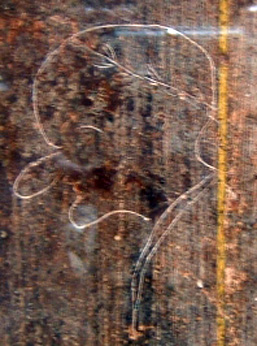
Other thoughts--technically, cave drawings were graffiti.... it has existed since at least ancient Greek times. This is an ancient Pompeiian caricature of a politician. Tell me that doesn't look like Mr. Magoo. Here's an example of some vintage Roman tagging:
There's graffiti on the Great Wall of China, and on the Coliseum wall ("Suspirium puellarum Celadus thraex: "Celadus the Thracian makes the girls sigh"). It's on Signature Rock along the Oregon Trail, and has continued to evolve. Now closely entwined with hip hop culture, it can be found on subway cars, buildings, walls, bridges, and at the death cites of Princess Di, Biggy, Tupac, Jim Morrison, and many others, as well as in modern art galleries and museums. A portion of graffiti is considering tagging, known for its gangsta influence and territorial nature--taggers go by nicknames and have unique styles.
For these reasons and public fear of vandalism and high crime rates, penalties for public defacing are stiff. You might remember Michael Fay, the kid who got caned in Singapore in 1994. He got caught tagging. Here in the states, Giuliani and Daley passed laws in the early nineties as part of their Anti-Graffiti Task Force (NY) and Graffiti Blasters (Chicago) that resulted in $350 fines, regulations as to the locked-upness of spray paint in stores, and speedy graffiti removal when phoned in. But like all forms of expression when repressed by government, it continues to speak. Loudly.
Here's what I wanted to accomplish with this project: 1) To show how the messages evoke a particular emotion, a triggered memory, a communal agreement/disagreement, humor, sadness, self-reflection, etc. 2) To pay attention to the materials used--paint, props, scenery, etc, and notice how they are part of the message 3) To examine graffiti as both social action and art. 4) To explore the themes in graffiti messages I saw repeated with little variation--love/heartbreak, anger/revenge, anarchy/politics, religion/living, pop culture/materialism.
There were a lot of considerations in making this movie, my first. First, learning how to use Windows Movie Maker, importing sorted pictures, setting the timing, choosing the accompanying music, etc. Especially after our last class meeting when semiotics was discussed, there was a feeling of interconnectedness through all these decisions, and I realized making movies was harder than just yelling "cut!" and "print!" and dealing with movie stars. Each independent element is a sign--I didn't want the music to change or offer interpretation to the messages, but I wanted it to somehow fit the discordant moods that would result from viewing themed messages. I had originally used "Psychobabble" by Frou Frou, as the timing of the beats fit well with the slide transitions, but the words imposed a coherent mood that couldn't contain the rampant emotional changes from viewing the message. I settled on a classical piece by Philip Glass which was in the movie The Hours, from a particular scene that featured walking down the streets of NYC, where there is a huge graffiti movement. I also wanted some slides to be held longer than others for reflection. I didn't arrange them in any order within their categories, which were love/heartbreak, religion/living, politics/anarchy, anger/revenge, materialism/pop culture, and (part two) those that incorporated the physicality of the surface or tool in the message itself. I chose to use my blog to explain all this, as I can include even more pictures and ideas than I could in a traditional paper.
Here 'tis, please enjoy (turn off my playlist first):
for my cultural theory in education class. will be back with regular posting jibber-jabber soon.
The way W.E.B. Du Bois writes is amazingly eloquent and rich while deeply intelligent and thoughtful. The back cover of his book (which you can read in full here) describes it as essential reading for everyone interested in African-American history and the struggle for civil rights in America, which excludes no one. Though most of us claim to be racism-free, I see traces of prejudiced legacy running through us that I do not wish to have and seek to eradicate but really do not understand. Some of the ideas that really stood out to me were the economic factors of the post-Civil War South, the influence of the New England schoolmarm, the true aims of education, race relations, and the question of the future and how we are going to get along in it.
At first I somehow missed the fact that TSoBF was first published in 1903, and wondered what Du Bois would say of today’s world and race relations. It seems like some of the race issues and what was going on in “black folks’ souls” have not changed drastically today, which perhaps is why I forgot it was written over a hundred years ago. I think our main problem today is still the color line. The legacy of the Freedmans’ Bureau (lawlessness and crime, page 24) continues to haunt the black image today, and the demoralizing camp life of the days following the Emancipation sound like a form of early ghettoism. Du Bois highlights for me some of the reasons why racism and prejudice against blacks remains so deep-seated and implacable even now in the 21st century, a sad state of affairs to say the least. Right from the beginning of the book, he clarifies the problems of poverty, bastardy (at the hands of white slave owners and lechers beyond 1865), the ballot and the school, and how “Negroes” (a term I have trouble using for obvious reasons in this day and age) had an abundance of the former and a serious deficit in equality of the latter. My white guilt cast a shadow over the pages as I read, wanting to weep for the injustices of the past, probably at the hands of my own ancestors. Nevertheless, the accomplishment of the Freedmans’ Bureau were impressive, mostly noticeably in the establishment of schools and enlisting help for the newly freed. I wondered briefly if any former slaves regretted their new-found liberty once the economic and legal oppression became even more starkly outlined as they attempted to live their lives (this thought resurfaced around pg. 110 as the author describes the daily life of the house servants, their intimacy and family ties with the family, and the consequences of the coming separation and class-forming of post-1865 life). What exactly is freedom, anyway?
“It is a hard thing to live haunted by the ghost of an untrue dream; to see the wide vision of empire fade into real ashes and dirt; to feel the pang of the conquered, and yet know that with all the Bad that fell on one black day something was vanquished that deserved to live, something killed that in justice had not dared to die; to know that with the Right that triumphed, triumphed something of Wrong…All this is bitter hard, and many a man and city and people have found in it excuse for sulking, and brooding, and listless waiting.” (48)
Du Bois is remarkable in that he draws his own life into his words but does not make the story about him. He cites politics through prose, and researches people to understand history, yet he does not demand specific actions, anarchy, or attitudes in response, nor does he attempt to justify or apologize for the past or present. He quietly asks through reason and passion for a revolution starting in the mind and the opening of it.
Another topic that Du Bois explores is the role of the New England schoolmarm—in the wake of national upheaval, these brave teachers educated a generation of ignorant people struggling to meet the outrageous demands of their new world. That image of the alphabet ringing out across the scorched fields will always stick with me. This made me feel a little better about myself, as I was a teacher myself, to know how important and vital the role of the educator was and is.
“To make here in human education that ever necessary combination of the permanent and the contingent—of the ideal and the practical in workable equilibrium—has been there, as it ever must be in every age and place, a matter of infinite experiment and frequent mistakes.” (57) Certainly this has bearing on our current situation of experimenting and mistake-making in educational policy-making and the state of public schools. More importantly, Du Bois stresses the true aim of education (and the real potential for learning) is through the interaction of human spirits, “the contact of living souls” (63), the developing of human reason, the sharing of stories and emphasis on the positive aspirations of mankind—certainly this should be our focus too as we educate children in today’s world of war, inequity, and prejudice.
Other chapters as Du Bois travels through post-war Georgia and comments on the lives and politics there reminded me of Gone with the Wind—a favorite book of mine since childhood, and a film I would watch with my mom whenever it was on TV. Romanced by the antebellum costumes and mansions and whatnot but somewhat ignorant as to the racial turbulence as a child, it was eye-opening to understand what was going on for black folk during this time. Margaret Mitchell presents a fairly accurate portrayal of the old South, garnered from conversations on porches with older folk who had lived through it, but older white folk. Another powerful book from this time period includes Roll of Thunder, Hear My Cry, told from the viewpoint of a young black girl in the rural South who watches her family struggle to keep their land as she herself experiences prejudice and racism at school and in town (two powerful social concepts Du Bois studies).
Another well-expressed concept is Du Bois’ approaches to studying race relations. Citing physical proximity, economic and political factors, intellectual contact and commerce, forms of everyday social contact, and religious enterprise as the six elements of race relations, he teases apart what this really means for a turn-of-the-century black American. Here again I hear echoes of 21st century American turmoil—the alignment of locations of homes to economic status allow for the worst of both races to see each other. There was some serious and illegal screwing-over of voiceless minorities, which we see today as well. Political activity, both then and now, seems to do little to seriously help blacks, or really anyone who was not white and rich. “So flagrant became the political scandals that reputable men began to leave politics alone, and politics consequently became disreputable.” (105) As Du Bois says on the next page, there is no way of telling how much one will be taxed, how the taxes are used, who makes such laws and how, who enforces them and how, etc. In 105 years, is that so far gone from our current system of government? The same can be said for the reasons and perspectives Du Bois cites for increases in black crime and the consequences of creating a jail culture in a seriously inequitable class society. We see similarities again in school funding along racial lines, now and then. In 1903, the author called for “a union of intelligence and sympathy” as the only real way to preserve the justice of the Republic—two things I unfortunately do not believe enough Americans possess in great quantities.
Du Bois turns from politics and economics in his last chapters on religion (The Preacher, The Music, and the Frenzy), the joyous birth and tragic death of his infant son, Alexander Crummell, the sorrow songs, and the confusions of John Jones as he attempts to make sense of the North, South, and subordination, eventually becoming a teacher. This conversation summed up my final thoughts best:
“John,” she said, “does it make everyone—unhappy when they study and learn lots of things?” He paused and smiled. “I am afraid it does,” he said. “And, John, are you glad you studied?” “Yes,” came the answer, slowly but positively. (149)