I read Push in a few hours, and I don't say that to brag. After four books on lit theory, a novel was a breeze. But it was a cold, shitty breeze that make me feel a lot of yuckiness inside. I know that's what everyone will touch on in their posts, how hard it was to read the story of a girl sexually abused by both parents, mother of two kids by her own father before high school, suffering from extreme confusion, depression, poverty, illiteracy, and HIV. Heavy. I know why we read it, what we were supposed to do--gauge our emotional reactions a la Rosenblatt. At the same time we could look at Precious' experiences with reading and writing. I did a little searching on Sapphire and the book, here's an interview. I thought this statement about purpose was interesting: "There's a blues song 'What's Been Done In the Dark Has to Come to the Light' and I think that's something that stays on my mind. I always want to bring out what's been hidden or marginalized. In Precious she is more misunderstood than invisible, we hear about her everyday. Every time Newt Gingrich opens his mouth it's about a welfare mother. I wanted to shed additional light. I wanted to show something behind the statistic. So yeah, I'm on a mission."
These things sparked me -- Precious' descriptions of feelings and people and places are child-like, very low-level from a professional standpoint, and yet they are more wisely phrased and profound than established professional writers, at least in provoking an emotional reaction:
"Can't he see I am a girl for flowers and thin straw legs and a place in the picture."
"There eyez is like far away spaceships."
"I'm alive inside. A bird is my heart."
"...I am sick of the walking dicks of Harlem."
"So my mother--one eye, no man, two children and the Bible."
"Sometime I wish I was not alive. But I don't know how to die. Ain' no plug to pull out. 'N no matter how bad I feel my heart don't stop beating and my eyes open in the morning."
Other strong themes I picked up on were the power of narratives (especially in the support group scene where Precious learns there are others like her, who have suffered like her), the bullshittiness of bureaucracy (the tests and reports and welfare trouble), and Precious' metamorphosis, best described by her list of what's important to her on pg. 109. Precious walks through Harlem and describes the filth and desperation of the ghetto, her hatred for crackheads and the ironic injustice of being considered one of their lot. Most of all I felt the worst seeing her struggle through the horrible confusion of the sexual abuse at such a young age, by her father. That was the worst. Luckily the love and acceptance she finds in friends and herself leads me to believe that she turned out ok after the last page was turned.
"Ms. Rain say one of the criticizsm of The Color Purple is it have fairy tale ending. I would say, well shit like that can be true. Life can work out for the best sometimes. Ms. Rain love Color Purple too but say realism has its virtues too. Izm, smizm! Sometimes I wanna tell Ms Rain shut up with all the IZM stuff. But she my teacher so I don't tell her shut up. I don't know what "realism" mean but I do know what REALITY is and it's a mutherfucker, lemme tell you."
skip to main |
skip to sidebar


View my page on Twenty Something Female Bloggers
View my page on Twenty Something Bloggers
 If you have time, watch this video I made. I want to be one of those people who have a bazillion views on their video.


About Me

- moxie
- "I stand for uncertainty, insecurity, surprise, disorder, unlawfulness, bad taste, fun, and things that go boom in the night." Tom Robbins
Literary Potpourri
- Not All That Interesting
- Speak on It
- Surviving Myself
- Texas Monthly
- Moxie's del.icio.us
- The Huff Po
- Jezebel
- Jennsylvania
- Boing Boing
- Damsel in Digress
- Never Been Cool
- Trickfist
- Good Things Come to Those Who Whine
- Adbusters
- People Reading
- The Stray Shopping Cart Project
- The "Blog" of "Unnecessary" Quotation Marks
- Photoshop Disasters
- I can has cheezburger?
- Crawling the Carpet Daily
- The Home Improvement Ninja
- Stranger to Sanity
- List Universe
- Distracted Spunk
- 20 something
- Bitch PhD
- Stuff White People Like
- The Typing Makes Me Sound Busy
- Shutter Sisters
- Go Fug Yourself
- sometimes its better out than in
- Chelsea talks smack
- found in pockets
- Robotman
- This is Not My Life
- The Lisa Show
- The Adventures of Tina and Mr. Bee
- Nicopolitan
- Distracted Spunk
View my page on Twenty Something Female Bloggers
View my page on Twenty Something Bloggers
If you have time, watch this video I made. I want to be one of those people who have a bazillion views on their video.
Labels
- 21st century literacy skills (5)
- 7th circle of hell (6)
- 90's music (1)
- 90210 (1)
- a moment of truth (1)
- ABCs (1)
- abstract (1)
- adbusters (1)
- adolescent (1)
- advertising (4)
- agency (1)
- air (1)
- Alamo Drafthouse (1)
- aliens (1)
- alvermann (2)
- amish (1)
- anarchy (3)
- angela thomas (1)
- angels (1)
- animation (2)
- annoyances (1)
- anus (1)
- arby's (1)
- Arrested Development (1)
- art (2)
- Art Institute (1)
- arts integration (1)
- asinine (1)
- austin (6)
- australia (1)
- authentic questions (1)
- bad ink (1)
- bad kids (2)
- bad television (5)
- bald mountain (1)
- Batman (1)
- Bauman (1)
- bears (1)
- beauty and the geek (1)
- beers (1)
- bender (1)
- bible (1)
- big happy hair (1)
- bill murray (1)
- birth control (1)
- birth order (1)
- black and white photography (1)
- black chris rock reading tatum adolescents (1)
- blogging (2)
- blonds (1)
- Bob Fecho (1)
- boobs (2)
- book review (1)
- books (4)
- boring (1)
- bourdieu (1)
- breakfast club (1)
- Briggs (1)
- bugs (1)
- bull creek (3)
- burgermeister (1)
- bus drivers (1)
- bush (2)
- Byzantium (1)
- caffeine (1)
- camus (1)
- cancer (1)
- cap metro (1)
- car wreck (1)
- cars (1)
- catherine adams (1)
- cavalier (1)
- Celadus the Thracian (1)
- celebrities (1)
- cemetery (1)
- Chicago (3)
- children's literature (1)
- Cho (1)
- choice (1)
- classic (1)
- cleaning (1)
- clinton (1)
- cloverfield (1)
- clowns (1)
- coliseum (1)
- commercials (2)
- condolences (1)
- congress (1)
- conspiracy theories (1)
- constructivist theory (2)
- contextualization (1)
- copyright (1)
- creativity (1)
- critical race theory (1)
- Csikszentmihalyi (1)
- culture (2)
- curriculum (4)
- CVS (1)
- CW (2)
- cyberpunk (1)
- cyborgs (1)
- day tv (1)
- daytime television (7)
- death (3)
- Dell (1)
- democrats (1)
- Devil's playground (1)
- digital literacies (2)
- discrimination (1)
- dogs (1)
- Don Adams (1)
- Donna Haraway (1)
- dreams (1)
- Dutch (1)
- easter (1)
- education (6)
- educational programming (1)
- educational standards (1)
- Elysium (1)
- environment (2)
- eternal damnation (1)
- evil (1)
- ewan macgregor (1)
- Faigley (1)
- fantasia (1)
- fear (2)
- feminism (1)
- film (1)
- firefighters (1)
- focus (1)
- food (1)
- ford fusion (2)
- ford taurus (1)
- found art (1)
- Fox (1)
- french (1)
- freud (1)
- friends (1)
- frontline (1)
- Frou Frou (1)
- Fulton (1)
- funds of knowledge (1)
- gameshow (1)
- Garrard McClendon (1)
- Gaughan (1)
- gender (1)
- generation x (1)
- geo metro convertible (1)
- Get Smart (1)
- Ghostbusters (1)
- ghosts (2)
- google (1)
- graffiti (4)
- graffiti tagging literacy writing art (3)
- grammar nazi (1)
- grave (1)
- great wall of china (1)
- greenbelt (1)
- Gulf coast (1)
- gyms (1)
- H2ED (1)
- hamlet (1)
- Hanna Montana (1)
- happiness (1)
- hawisher and selfe (1)
- heart (1)
- heat rash (1)
- Heath Ledger (1)
- heebie geebies (1)
- hero (1)
- hiking (1)
- history (1)
- holiday (1)
- home ec (1)
- homestead trail (1)
- hoover's (1)
- horrors (1)
- house renovation (1)
- hydrocodone (1)
- hypertext (1)
- I35 (1)
- identity (3)
- ideology (1)
- idiot (1)
- Illinois (1)
- injustice (1)
- intelligence (2)
- interior design (1)
- internet (3)
- interpretation (1)
- Iowa (2)
- ipod (1)
- ISS (1)
- Jack Valenti (1)
- james brown (1)
- James Gee (1)
- jerk (1)
- jerry uelsmann (1)
- Jim belushi (1)
- Jim Morrison (1)
- jobs (1)
- Johnny fairplay (1)
- joy (1)
- judd nelson (1)
- karma (1)
- Kate Eric (1)
- kids (2)
- krav maga (1)
- la la's (1)
- land (1)
- language ideologies (1)
- Lauren Cleary (1)
- learning (1)
- lesbians (1)
- Lessig (1)
- life (7)
- light bulbs (1)
- lightning thief (1)
- literacy (5)
- Literacy in American Lives (1)
- literature as exploration (4)
- littering (1)
- little women (1)
- lou gossett jr. (1)
- love (6)
- Lubbock (1)
- manchaca (1)
- Maria's (1)
- maurice sendak (1)
- McCarthey (1)
- mckinney state falls (1)
- media (1)
- Meg Whitman (1)
- mentoring (1)
- metacognition (1)
- Michael Fay (1)
- mickey mouse (1)
- middle school (2)
- Miles Myers (1)
- Millenium Park (1)
- miracle (1)
- miss cleo (1)
- monkey business (1)
- monkeyshine (1)
- montage (1)
- montel (1)
- moon (1)
- morality (1)
- mosquito (1)
- moulin rouge (1)
- movies (5)
- mullet (1)
- multimodality (1)
- muscular sclerosis (1)
- museum (1)
- music (2)
- MXC (1)
- Myers (2)
- myspace comments (2)
- neighborhood (1)
- new car (1)
- new literacies (1)
- New London Group (1)
- nightmares (1)
- non-literate (1)
- nova (1)
- obama (3)
- Old Navy (1)
- Olson (2)
- ophelia (1)
- originality (1)
- outline of a theory of practice (1)
- ownership (1)
- palo duro (1)
- paranormal (1)
- passion (1)
- patience (1)
- PBS (1)
- pee (1)
- penis (1)
- performance (1)
- peter weller (1)
- Piaget (1)
- piano (1)
- picturesonwalls (1)
- play (1)
- poetry slam (1)
- politics (4)
- polygraphs (1)
- pootie tang (1)
- popsicles (1)
- porn (1)
- portfolio assessment (1)
- postmodernism (1)
- power (1)
- power dynamics (1)
- powerpoint (2)
- presentations (1)
- Princess Di (1)
- public places (1)
- public transportation (1)
- pulp fiction (1)
- puppy (1)
- Push (1)
- queer theory (1)
- questions (2)
- racism (1)
- raisin in the sun (1)
- rant (1)
- reader response (2)
- reading (6)
- reading strategies (1)
- reality bites (2)
- recycling (1)
- rednecks (2)
- reincarnation (1)
- reinventing english (1)
- religion (3)
- religious crazies (1)
- republicans. (2)
- retarded (1)
- rheingold (1)
- robotcop (1)
- rod stewart (1)
- role models (1)
- Roll of Thunder (1)
- Room Store (1)
- rosenblat (1)
- Rosenblatt (3)
- rumspringa (1)
- safety (1)
- Sapphire (1)
- scary (2)
- school (1)
- school improvement (1)
- seance (1)
- self talk (2)
- seventh circle of hell (2)
- sex (1)
- sexuality (2)
- shenanigans (2)
- Shihan (1)
- Shipka (1)
- Siegel (1)
- sign systems (1)
- Signature Rock (1)
- singles (1)
- SITC (1)
- sitemeter (1)
- Smagorinsky (1)
- Small Wonder (1)
- smart mobs (1)
- Smirnoff Orange Vodka (1)
- SNL (1)
- social messages (1)
- society (1)
- sorority (1)
- soul (2)
- Souls of Black Folk (1)
- South Padre Island (1)
- speakers' bureau (1)
- spelling bee (1)
- Spigelman (1)
- spike jonze (1)
- spirits (1)
- standoff (1)
- starbucks (1)
- steven johnson (1)
- stories for bad children (1)
- student loans (1)
- student-centered classroom (1)
- stupidity (1)
- substitute teaching (1)
- subway (1)
- suicidal tendencies (1)
- suicide (1)
- supreme court (1)
- survivor (1)
- swat (1)
- swimming (1)
- sylvia brown (1)
- symbol (1)
- tagging (2)
- TAKS (1)
- teacher development (1)
- teacher education (1)
- teaching (8)
- technology (1)
- television (2)
- text (2)
- texting (2)
- the Challenger (1)
- The Hours (1)
- the loft (1)
- the other side (1)
- the principal (1)
- the reader the text the poem (2)
- The Strangers (1)
- theft (2)
- theory (1)
- this post kinda sucked cause I was distracted (1)
- time (1)
- titanic (1)
- toilet paper (1)
- Tom Robbins (1)
- tools (1)
- transactional theory (1)
- transformers (1)
- travel (1)
- Tupac (1)
- tv (2)
- twin falls (1)
- tx (1)
- UT (1)
- UTHS (1)
- vandalism (1)
- Viktor Frankl (1)
- virgin suicides (2)
- vocational school (1)
- W.E.B. Du Bois (1)
- waiting (1)
- weird (1)
- west texas (2)
- where the wild things are (1)
- whoring (1)
- Wii (1)
- william wegman (1)
- Wilson Pickett (1)
- word (1)
- work (2)
- writing (1)
- zombies (1)
Go here for stuff
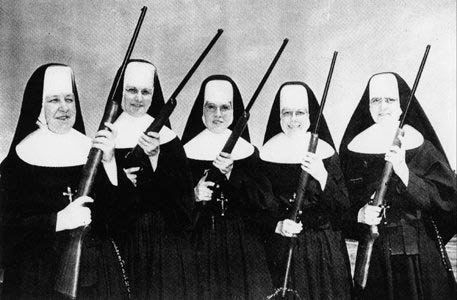
nuns with guns
To Read (should you feel like buying me something)
- Cathedral, David McCauley
- Male and Female, Margaret Mead, 1949
- Life of Pi, Yann Martel, 2005
- Wisdom Sits in Places, Keith Basso, 1996
- The Feminine Mystique, Betty Friedan, 1963
1 comment:
Dammmmmnnnn! You took my post lead with your last quotation. Oh well, on to plan 'B'. Also, thanks for diggin' up the info on Sapphire. Nice touch. I too felt the "yuckiness" at times during my "live encounter" with the text, but I also had moments when I literally cheered outloud. I forgot how much fun it is to be fully engaged in a piece of literature.
Post a Comment