je
Full story
Monday, April 21, 2008

Saturday, April 19, 2008
"the productive pursuit of serious fun"

For the fifth time over the last year, I left my Macbook charger at work. Work meaning school, meaning not open again til Monday. No problem, I thought, pulling out the heavy Dell. I turned it on and frowned--the screen was all skittery and crazy. I panicked--I did not know if I could make it three days without internet. How would I know what's going on? Talk to people? Read random things? Write? Check things? Find new things? Then Roommate #1 told me to give it a little slap on the side, and sure enough, things straightened out. You know, like how you slap someone freaking out to calm them down. This anecdote serves to illustrate Thomas and friends' points about the ubiquity of digital literacies.
Angela Thomas takes on a lot of cool topics like cyborgs, cyberpunk, myspace, sexual identities, and Freud in her article, Digital Literacies of the Cybergirl. I've always been fascinated with the body/soul connection, and it was interesting to see how that plays out in cyberspace and in identity-construction. I was reminded of a 60 Minutes or Dateline or some such melodramatic program about the overwhelming popularity of Myspace and its effects on teens, some with tragic endings. I remembered this girl, who was kind of a loser at her school and very lonely, had a penchant for edgy clothes, hair, and makeup and picture-taking talent became an almost overnight cyberlebrity (I made up that word), with hundreds of complete strangers adoring, friending, and commenting on her Myspace page. It was edgy, but not over the line skanky like some profiles you'll run across. However school officials and parents were notified, undies were bundled, and the girl's parents made her delete her profile and her pictures. A tear slid down her face as she remembered how they stood behind and made her erase herself. In real life, she was the weird girl who wasn't skinny or mainstream enough to be liked, but online she was a queen.
Thomas uses some Freud (which you don't see much) to discuss our obsession with the visual, using the term "scopophilia," meaning pleasure in looking, to describe one of the most important of our human drives. This could explain why Martino's study found that young males like porn. And see here is where writing may or may not show the note of sarcasm in my voice right now. Thomas studies the choice of avatar used in girls' profile, and although I see what she's saying, I think she went to far in her interpretation and classification of her subjects' choices. That seemed a little too subjective. I think the influence of the Barbie and Bratz dolls lining our shelves and our Disney princesses and our adoration of cinema waif-ers should be included in any discussion of beauty and its interpretation.
Haraway's A Cyborg Manifesto is now on my to-read list: "The boundary between science fiction and social reality is an optical illusion." Returning to the ideas of the bodyembodiment, and reality, I am reminded of Dwight's Second Life from The Office:
Incidentally, I watched my friend Dana play Sims Bustin Loose over the weekend, as she made and lost friends, slept, forgot to go to work, and sat in a hottub--all of which she does in real life as well.
I noticed while reading the Lanshear and Knobel piece that I can't read linearly online. My eyes jump around, I click on links, I skip sentences, but eventually it all gets read. I totally love Adbusters. I love that the authors used two of my favorite words--gonzo and karma. Lankshear and Knobel spend the second half of the article thoughtfully discussing research approaches to new literacies after wowing readers with the possibilities they hold.

Culture jamming should be a national past time. It should be a required course, a degree program, a profession, an Olympic sport. We need to be asking questions, people. Getting to the bottom of things. Or at least making fun of them. An earlier post of mine features an Onion video of Bush giving a press conference on the threat of zombie attacks (check the tag 'zombies' to your right). I checked out Plastic and I like it. "Plasticians tend to be self-styled members of an erudite, ironic and humorous ‘plugged in’ crowd, interested in quirky takes on anything newsworthy—particularly anything connected with popular culture—as well as in serious and informed discussion of current events." That's me, ironic. I like blogs for making it easy to zoom around and link these things, to check sources, to organize the mountains of content, for incorporating visual, text, and video. And I'm very critical of blogs too--if I had a dollar for every proud mother's blog consisting of 5-10 daily pictures of her bliss-bundle and inane commentary on surbuban domestic whathaveyou, I could probably buy one of those babies. You can see for yourself, just click "next blog" up in the top left (after reading mine, of course) and blogger will take you to a random blog. There's actually a game where you do that and see how many blogs you can click through before stumbling upon a porn blog. I think the record is 10). From what I've seen, there is a big handful of intelligent blogs that concern themselves with provoking thought, asking questions, encouraging discussion. And there's a big old bucket full of, well, crappy blogs. I just hope that more attention is pulled towards the relevant stuff of life, and less toward celebrity gossip and silly wastes of time. As long as the blog serves its author's purpose, people can do whatever they want with it. In regards to their ability to cross-reference quickly, incorporate media, and allow for collaboration, blogs are rad.
The Hawisher and Selfe article was very long, because their point (I think) is the complexity of how one comes to digital or new literacies. Obviously inspired by Brandt's sponsors of literacy book, these authors draw some important conclusions about conditions of access to technology, literacies' life spans, personal agency, the role of school and family as gatekeepers, and generational transfer of digital know-how. As in many studies, the authors call for improved teacher training so that we may fully use technology to its most beneficial. Resource inequities are a tragic problem for underfunded, under-served schools, and really puts those schools' kids at a serious disadvantage as reliance on technology in the workplace only grows and grows and higher education becomes more and more expensive. Although, as the authors say, the schools are not necessarily the biggest or most important sponsor of literacy. I'm often reminded of the 8th grade student who gleefully confided in me about his ability to get around the firewalls set in place by AISD servers, thus accessing his precious Myspace account. That's real problem solving. Too bad there are no TAKS questions on that.
The rich keep getting richer, the poor continue to get poorer. But that's another post.
The end.
Thursday, April 10, 2008
"Jender"

Wayne Martino really knows how to start out an article. You remember how your English teacher used to talk about having a attention-getting first sentence?
"Boys who enjoy reading or like English have been referred to as 'faggots', 'squids', 'spocks', 'try-hards or simply just as rejects by their peers."
Well. Ok then.
Incidentally, Martino also wrote a chapter entitled "Dickheads, Wuses, and Faggots: Addressing Issues of Masculinity and Homophobia in the Critical Literacy Classroom for a book. While I appreciate Martino's daring word choice and agree to the inclusion of this issue for research's sake, I contest his spelling of "wusses." Dictionary.com backs me up.
Not surprisingly, Martino finds that boys disengage with passive, "feminized" activities, into which they (a bunch of Australian boys) group reading--clearly these boys have not read any transactional theory a la Rosenblatt. Less surprisingly, Martino claims boys like...porn. Here Martino draws upon his gender argument, that concepts of masculinity and male literary practices blah blah blah--look, his "study" interviewed boys on their thoughts on reading, and they either said they didn't like it and it was boring, they like some types of texts (sci-fi or adventure or sports) or they liked it a lot and saw it as an escape from reality. I don't think Martino's telling us anything new or significant. All students at times express these thoughts (that reading is boring, that only certain books are any good), and during adolescents, they are constantly trying on new identities and attitudes to assert their independence and show they are tough--it was around this age that I first savored the full power of a well-delivered F Bomb. I applaud Martino for using the word "tits" in an academic article (in quoting a participant), but I'm not impressed by his "study."
Mollie Blackburn, on the other hand, study the out-of-school literacies and power held and experienced by LBGTQ youth while working for and researching literacy performances at The Loft in NY for a number of years. She knows that kids are only in school part of the time, and that away from school, they are both aware of the power dynamics at play in ident
 ity formatice and literacy, and work to change them. In this study, this is done by collaborating on a glossary of terms used to describe LBGTQ people, thereby taking the power of labeling out of the hands of outsiders and re-situating their own identities and definitions. She draws on queer theory, critical race theory, and critical feminism (all of which slightly contradict each other--queer theory seeks to suspend classifications of identity while critical feminism makes gender the center of issues studied, same with CRT with the concept of race) to approach the multiple identities working within this group and these performances. Moreover, she stresses the power of literacy performances for social justice and change. The Speaker's Bureau, a noted group within the Loft) works to disrupt power dynamics by educating others about homophobia and heterosexism (which assumes that everyone is straight). To be gay, a female, and a minority...Gloria Alzadua's writing continues to poke me in the back as I try to read other things (when I get home, I'll get out Borderlands to find the quote I'm thinking of).
Finally, Barbara Kamler looks at gender in early childhood writing, finding that despite being given freedom to choose their topics, children in Australia (what's with all the Aussies?!) typically wrote in the observation genre, reporting on what they've seen and done in their own lives. Boys in this study overwhelming wrote themselves into their stories as active do-ers while girls positioned themselves as passive experiencers (can't say I'd have fallen into that myself--the stories I used to write in elementary school were usually made up, and I typically made myself the superhero of the tale, so what does that say? Furthermore, I once pitched a fit at McDonald's because I wanted a Transformer in my Happy Meal and not a damn doll--I was the inheritor of a great collector of Matchbox cars from my older brother and a single Barbie with crappy clothes and a Ken doll whose head consistently came off from my sister). Anyway, Kamler's study (which includes only 2 children although she studied them for almost 3 years) argues that "children, as they learn to write are gaining control not only of the written mode of language, but also of the gendered meanings of their culture." I don't contest that point at all, but as with the Martino study, there are so many complex and variable influences on one's identity that work together and in juxtaposition with each other; gender and the context in which it's presented throughout childhood is only one factor.
Kamler argues that gender is often overlooked, but I pose a different question--if we are lending credence to the shaping concepts of gender on identity, what impact does the overwhelmingly female teaching population have on education? How do male and female roles play out in the minds of the young when they typically see female teachers and male administrators? What do they think of power dynamics when Mom does the cleaning and Dad has the job? When the plumber and the mechanic and the electrician are all men, and the waitress and the flight attendant and the maid are all women? All of these decisions are fine, do whatever you want to do with your life, but we should be providing narratives of "non-standard" or non-traditional gender roles as well.
Kamler's weakness (besides using a single pair for study) lies in attributing to particular writing behaviors and choices to gender, when little Peter and little Zoe were many things besides a little boy and a little girl--they were white (I'm assuming), Australian, members of a family and community and town, possibly little brother or little sister--all these things went into their choices, not just gender. Everything we know about how to act is a product of our socialization, and is socially reproduced when we reduce some behavior as a trait of gender. Hence the title of this post--I (Jen) am who I am, talk like I talk, write and read like I write and read because of who I am, not just because of my gender or race, etc.
Just in case gender confuses you, however, here's Zachary to clear things up:
Also, here is a sheik describe the difference between men and women:
We can laugh about it, and it's something we'll fight each other on til the end of time, and it provides much of the fodder used in sitcoms, but when it comes to discrimination and oppression, I will second Kiri's directive from Blackburn's article in saying, "suck my cock."
Sunday, April 6, 2008
Post No. 93

While subbing on Friday, I let a kid go to the bathroom. Not in the room of course. A black girl urgently raised her hand and told me he wasn't allowed to leave the room. "Why?" I asked. "Because he...he be doin bad!" she exclaimed. I raised an eyebrow but smiled, knowing exactly what she meant despite her "non-standard grammar."
So Garrard McClendon came up with a book called Ax or Ask? The African American Guide to Better English to solve a crisis of "low expectations" faced by the black community. In the beginning of this interview, he cites reasons for said crisis panic: 64% of black fourth graders are considered functionally illiterate, and blacks are trailing 200 points behind whites and Asians on the SAT. This gives me plenty of hole-poking opportunities, but I'll be brief--"functionally illiterate" doesn't mean shit in light of the semester-long conversation we've been having about what literacy really means, and standardized tests are just silly--those are hoops you jump through to join the Discourse of the business/social world, and the hoops seem to be on fire to boot for blacks (for many deep, messy, and resistant reasons).
I was a little dubious but then he went on to talk about code-switching via a weird analogy about chameleons (the first of many interesting metaphors) and honoring both dialects, so I kept watching. He contradicts himself about giving dignity to both BVE and Standard English around 3 minutes, saying teachers are not aggressive enough about "correcting" primary students' using their home language, suggesting there is something wrong with it at least in academic circles which the authors of this week's articles would have a problem with. Lisa Delpit is cited, for better or worse. He makes some good points.
What's more interesting than Carlton Banks (sorry, couldn't help it) is the discussion and comments in regards to this video on youtube. People have some strong opinions about their and others language in terms of what's right and wrong--reminded me of Gloria Azaldua's Borderlands, a controversial and angry book about the linguistic crossroads of the mestiza. She writes, "Chicanas who grew up speaking Chicano Spanish have internalized the belief that we speak poor Spanish. It is illegitimate, a bastard language. And because we internalize how our language has been used against us by the dominant culture, we use our language differences against each other...if a person, Chicana or Latina, has a low estimation of my native tongue, she also has a low estimation of me." The inherent political and racial tension about language isn't restricted to any one dialect or language. Another good video to watch and further proof that Obama needs to get elected can be found here, just scroll down and watch some baracktv about race relations and how students talk about them in a Bronx high school.
I'm not denying there's an achievement gap or racism in hiring practices or any of that. What's discouraging is the resistance and chaos involved in trying to have conversations about these issues--the entire country went nuts after seeing Obama's pastor demonstrate only slightly more than the typical zest seen in most black churches (yes, I'm white, but I have been to black churches in Chicago, and fiery is a good description). Just the topics of racism themselves have people struggling to get a grip on their own opinions and confrontations of racism, and it's all around us. I think standup comedians do the best job of approaching racism, and they can get away with it by wrapping it in a joke.
In Cooks and Ball's lit review of the research on AAVE-speaking adolescents' literacies, they make a valid point, that there are many published works decrying the failures and trouble of Black English speakers (same as the panic-inducing approach for most initiatives, i.e. Nation at Risk) but few focus on providing models of culturally-relevant pedagogy or teacher development. They also suggest more research be done on student writing, technology, and alternative assessment methods, which I think would help most educational dilemmas facing us right now.
"Critically, and futuristically as US society becomes increasingly diverse, we must arrive at a genuine acceptance of the fact that difference does not mean deficiency." (Smitherman, 79)
Smitherman's research with the National Assessment of Education Progress looks at twenty years of black students' writing, and includes a set of criteria for black student writing, such as cultural references, verbal inventiveness, and evocative language. I imagined the melee that would doubtless ensue if a white writer had attempted to do such a thing. Or, even funnier, how about a list of features of white writing?
Incidentally, did you know that 2005 was The Year of Languages in America? Me either.
I took an African American Lit class as an undergrad and was the only white girl in a class of sixty or so. More interesting than that was the professor, a tiny old Korean lady whose second language for her major was Ebonics. Anyway, during that same semester I took an awful grammar class where the entire time was spent diagramming sentences. It taught me nothing, other than I don't like diagramming sentences. It's this kind of approach Godly, Carpenter, and Werner writes about in our third article. The idea too many teachers are espousing involves spending a little time daily on decontextualized and sterile grammar instruction (in the form of correcting sentences, doing practice test items, etc--I've done them) in hopes of raising standardized test scores. By the way, research has shown that explicit grammar instruction doesn't improve student writing. The tests are multiple choice, thus promoting the idea that there is only one correct way to use language and denying students any opportunity to argue or explain their decisions. The authors mentioned Brian Street's ideological theory of literacy, as opposed to an autonomous one, and argue for focusing classroom talk on the power of language ideologies similar to those studied in the other articles. "Like most ideologies, language ideologies have been shown to be most powerful when they are hegemonic, that is, when they are believed to be so natural, so unquestioning true, that their power is not recognized, even by those whom they position as subordinate. For instance, many people do not question the power inherent in the widely held belief that Standard English is the purest, most logical, and most grammatical form of the language." (105)
I liked this study because it examined the sources of these language ideologies--state and district standards and standardized tests, curricular materials, activity structure, teacher talk, and student talk. It also describes the frustration of a well-intending teacher who did what she was told as far as grammar instruction and teaching to the test, and realized upon seeing the tapes from the study on her teaching and classroom how far short that fell. Instead of positioning teachers as the sole possessors of knowledge and the ultimate authorities on language, "literacy education should reflect the necessity and possibility of responsive and responsible uses of language in a world rife with and riven by systems and relations of power."
All that said, it still bothers me when people don't use proper grammar. Is that bad? I'm not talking about ebonics or whatever, I mean when people write things like "your stupid." My stupid what, idiot?
Friday, April 4, 2008
Alaiyo
I wrote "a blog for class" as a descriptor to this blog, as it was originally an assignment for a class. Over time the phrase began to evolve--class. for class. a blog for class...
If you read this thing semi-occasionally, I thank you. Things might take a turn towards academia for a while, as I now have another class requesting blog entries as assignments, Research Seminar in the English Language Arts. Expect articles, theory, education, television, rants, silliness, governmental conspiracies, randomness, and cries for help to ensue.
Today, though, I subbed for a middle school language arts class and showed the play A Raisin in the Sun (fantastic). Alaiyo was the nickname Beneatha's boyfriend from Nigeria gave her--it means "one for whom food is not enough" in Yoruba. The next entry will be talking about language, grammar instruction, ideologies (in case you want to clear your calendar), and why we teach as if there's any absolute truths or best ways anyway. It's analogous to watching the "beauties" of Beauty and the Geek to answer questions about museum pieces or science projects when the geeks simply tell them to memorize the answers--when people start asking questions and you really have to be able to show you really understand, you're screwed. Standardized testing. You know. You know?
Anyway, a student gave me this picture she drew, and I had a hard time not laughing or saying, "what the hell is this?"
 To be clear, at no point did I ever bare midriff, nor did I sit on any desk like that, so I was a big confused. I also do not own a pink blouse and am not a camel toed fairy. Underneath it said "to my favorite teacher," which is an odd thing to say to a sub, even one you know fairly well, and there was an anime book on her desk, so I figured she just drew it and then decided to give it to me. Cause, uh, no.
Also--I had to call AISD today and the hold music for HR is none other than Night on Bald Mountain. Odd music to hold to. Doesn't ring a bell?
Good to be writing again. Been so busy.
Wednesday, March 19, 2008
May 17, Here I Come!
Reprint - As I get closer and closer to graduating from UT with my masters degree, I find myself looking back over the last two years for what sticks out. I read dozens of books, hundreds of articles, brazillions of papers (slightly exaggerating here), participated in many discussions, listened to lectures, took notes, did research, etc, etc, etc. I know how privileged I am to have done this. So I think as far as my own products, the stuff that I wanted to get into and designed myself, I'm most proud of my graffiti project, my blog as a whole, and my research on juvenile correction facility curriculum. Because I've been a bit of a slacker lately as far as writing new stuff, I reprint for you below my graffiti project.
This project is about graffiti. I've been working on it since about the middle of the semester, recognizing early on that graffiti was an exception to the regular rules and theories about literacy, writing, art, and communicating. Despite its power in sending political and social messages, it's a crime. Regardless of what is written, the physical act is defacing "public" property, intellectual shared space set in the widest cultural context possible--people and life. The message has to be short and powerful, in a certain place. I got my pictures from a fantastic website which contains 500 images of graffiti photographed from all over the world, updated weekly. This site is a publishing house/record label type of thing, very cool.
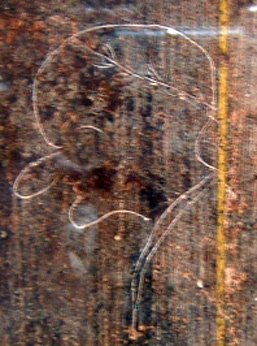
Other thoughts--technically, cave drawings were graffiti.... it has existed since at least ancient Greek times. This is an ancient Pompeiian caricature of a politician. Tell me that doesn't look like Mr. Magoo. Here's an example of some vintage Roman tagging:
There's graffiti on the Great Wall of China, and on the Coliseum wall ("Suspirium puellarum Celadus thraex: "Celadus the Thracian makes the girls sigh"). It's on Signature Rock along the Oregon Trail, and has continued to evolve. Now closely entwined with hip hop culture, it can be found on subway cars, buildings, walls, bridges, and at the death cites of Princess Di, Biggy, Tupac, Jim Morrison, and many others, as well as in modern art galleries and museums. A portion of graffiti is considering tagging, known for its gangsta influence and territorial nature--taggers go by nicknames and have unique styles.
For these reasons and public fear of vandalism and high crime rates, penalties for public defacing are stiff. You might remember Michael Fay, the kid who got caned in Singapore in 1994. He got caught tagging. Here in the states, Giuliani and Daley passed laws in the early nineties as part of their Anti-Graffiti Task Force (NY) and Graffiti Blasters (Chicago) that resulted in $350 fines, regulations as to the locked-upness of spray paint in stores, and speedy graffiti removal when phoned in. But like all forms of expression when repressed by government, it continues to speak. Loudly.
Here's what I wanted to accomplish with this project:
1) To show how the messages evoke a particular emotion, a triggered memory, a communal agreement/disagreement, humor, sadness, self-reflection, etc.
2) To pay attention to the materials used--paint, props, scenery, etc, and notice how they are part of the message
3) To examine graffiti as both social action and art.
4) To explore the themes in graffiti messages I saw repeated with little variation--love/heartbreak, anger/revenge, anarchy/politics, religion/living, pop culture/materialism.
There were a lot of considerations in making this movie, my first. First, learning how to use Windows Movie Maker, importing sorted pictures, setting the timing, choosing the accompanying music, etc. Especially after our last class meeting when semiotics was discussed, there was a feeling of interconnectedness through all these decisions, and I realized making movies was harder than just yelling "cut!" and "print!" and dealing with movie stars. Each independent element is a sign--I didn't want the music to change or offer interpretation to the messages, but I wanted it to somehow fit the discordant moods that would result from viewing themed messages. I had originally used "Psychobabble" by Frou Frou, as the timing of the beats fit well with the slide transitions, but the words imposed a coherent mood that couldn't contain the rampant emotional changes from viewing the message. I settled on a classical piece by Philip Glass which was in the movie The Hours, from a particular scene that featured walking down the streets of NYC, where there is a huge graffiti movement. I also wanted some slides to be held longer than others for reflection. I didn't arrange them in any order within their categories, which were love/heartbreak, religion/living, politics/anarchy, anger/revenge, materialism/pop culture, and (part two) those that incorporated the physicality of the surface or tool in the message itself. I chose to use my blog to explain all this, as I can include even more pictures and ideas than I could in a traditional paper.
Here 'tis, please enjoy (turn off my playlist first):
This project is about graffiti. I've been working on it since about the middle of the semester, recognizing early on that graffiti was an exception to the regular rules and theories about literacy, writing, art, and communicating. Despite its power in sending political and social messages, it's a crime. Regardless of what is written, the physical act is defacing "public" property, intellectual shared space set in the widest cultural context possible--people and life. The message has to be short and powerful, in a certain place. I got my pictures from a fantastic website which contains 500 images of graffiti photographed from all over the world, updated weekly. This site is a publishing house/record label type of thing, very cool.
Other thoughts--technically, cave drawings were graffiti.... it has existed since at least ancient Greek times. This is an ancient Pompeiian caricature of a politician. Tell me that doesn't look like Mr. Magoo. Here's an example of some vintage Roman tagging:
- Quisquis amat. veniat. Veneri volo frangere costas fustibus et lumbos debilitare deae.
- Si potest illa mihi tenerum pertundere pectus
- quit ego non possim caput illae frangere fuste?
- Whoever loves, go to hell. I want to break Venus's ribs with a club and deform her hips.
- If she can break my tender heart
- why can't I hit her over the head?
- -CIL IV, 1284.
There's graffiti on the Great Wall of China, and on the Coliseum wall ("Suspirium puellarum Celadus thraex: "Celadus the Thracian makes the girls sigh"). It's on Signature Rock along the Oregon Trail, and has continued to evolve. Now closely entwined with hip hop culture, it can be found on subway cars, buildings, walls, bridges, and at the death cites of Princess Di, Biggy, Tupac, Jim Morrison, and many others, as well as in modern art galleries and museums. A portion of graffiti is considering tagging, known for its gangsta influence and territorial nature--taggers go by nicknames and have unique styles.
For these reasons and public fear of vandalism and high crime rates, penalties for public defacing are stiff. You might remember Michael Fay, the kid who got caned in Singapore in 1994. He got caught tagging. Here in the states, Giuliani and Daley passed laws in the early nineties as part of their Anti-Graffiti Task Force (NY) and Graffiti Blasters (Chicago) that resulted in $350 fines, regulations as to the locked-upness of spray paint in stores, and speedy graffiti removal when phoned in. But like all forms of expression when repressed by government, it continues to speak. Loudly.
Here's what I wanted to accomplish with this project:
1) To show how the messages evoke a particular emotion, a triggered memory, a communal agreement/disagreement, humor, sadness, self-reflection, etc.
2) To pay attention to the materials used--paint, props, scenery, etc, and notice how they are part of the message
3) To examine graffiti as both social action and art.
4) To explore the themes in graffiti messages I saw repeated with little variation--love/heartbreak, anger/revenge, anarchy/politics, religion/living, pop culture/materialism.
There were a lot of considerations in making this movie, my first. First, learning how to use Windows Movie Maker, importing sorted pictures, setting the timing, choosing the accompanying music, etc. Especially after our last class meeting when semiotics was discussed, there was a feeling of interconnectedness through all these decisions, and I realized making movies was harder than just yelling "cut!" and "print!" and dealing with movie stars. Each independent element is a sign--I didn't want the music to change or offer interpretation to the messages, but I wanted it to somehow fit the discordant moods that would result from viewing themed messages. I had originally used "Psychobabble" by Frou Frou, as the timing of the beats fit well with the slide transitions, but the words imposed a coherent mood that couldn't contain the rampant emotional changes from viewing the message. I settled on a classical piece by Philip Glass which was in the movie The Hours, from a particular scene that featured walking down the streets of NYC, where there is a huge graffiti movement. I also wanted some slides to be held longer than others for reflection. I didn't arrange them in any order within their categories, which were love/heartbreak, religion/living, politics/anarchy, anger/revenge, materialism/pop culture, and (part two) those that incorporated the physicality of the surface or tool in the message itself. I chose to use my blog to explain all this, as I can include even more pictures and ideas than I could in a traditional paper.
Here 'tis, please enjoy (turn off my playlist first):
Tuesday, March 18, 2008
The Souls of Black Folk, by W.E.B. Du Bois: A Review

for my cultural theory in education class. will be back with regular posting jibber-jabber soon.
The way W.E.B. Du Bois writes is amazingly eloquent and rich while deeply intelligent and thoughtful. The back cover of his book (which you can read in full here) describes it as essential reading for everyone interested in African-American history and the struggle for civil rights in America, which excludes no one. Though most of us claim to be racism-free, I see traces of prejudiced legacy running through us that I do not wish to have and seek to eradicate but really do not understand. Some of the ideas that really stood out to me were the economic factors of the post-Civil War South, the influence of the New England schoolmarm, the true aims of education, race relations, and the question of the future and how we are going to get along in it.
At first I somehow missed the fact that TSoBF was first published in 1903, and wondered what Du Bois would say of today’s world and race relations. It seems like some of the race issues and what was going on in “black folks’ souls” have not changed drastically today, which perhaps is why I forgot it was written over a hundred years ago. I think our main problem today is still the color line. The legacy of the Freedmans’ Bureau (lawlessness and crime, page 24) continues to haunt the black image today, and the demoralizing camp life of the days following the Emancipation sound like a form of early ghettoism. Du Bois highlights for me some of the reasons why racism and prejudice against blacks remains so deep-seated and implacable even now in the 21st century, a sad state of affairs to say the least. Right from the beginning of the book, he clarifies the problems of poverty, bastardy (at the hands of white slave owners and lechers beyond 1865), the ballot and the school, and how “Negroes” (a term I have trouble using for obvious reasons in this day and age) had an abundance of the former and a serious deficit in equality of the latter. My white guilt cast a shadow over the pages as I read, wanting to weep for the injustices of the past, probably at the hands of my own ancestors. Nevertheless, the accomplishment of the Freedmans’ Bureau were impressive, mostly noticeably in the establishment of schools and enlisting help for the newly freed. I wondered briefly if any former slaves regretted their new-found liberty once the economic and legal oppression became even more starkly outlined as they attempted to live their lives (this thought resurfaced around pg. 110 as the author describes the daily life of the house servants, their intimacy and family ties with the family, and the consequences of the coming separation and class-forming of post-1865 life). What exactly is freedom, anyway?
“It is a hard thing to live haunted by the ghost of an untrue dream; to see the wide vision of empire fade into real ashes and dirt; to feel the pang of the conquered, and yet know that with all the Bad that fell on one black day something was vanquished that deserved to live, something killed that in justice had not dared to die; to know that with the Right that triumphed, triumphed something of Wrong…All this is bitter hard, and many a man and city and people have found in it excuse for sulking, and brooding, and listless waiting.” (48)
Du Bois is remarkable in that he draws his own life into his words but does not make the story about him. He cites politics through prose, and researches people to understand history, yet he does not demand specific actions, anarchy, or attitudes in response, nor does he attempt to justify or apologize for the past or present. He quietly asks through reason and passion for a revolution starting in the mind and the opening of it.
Another topic that Du Bois explores is the role of the New England schoolmarm—in the wake of national upheaval, these brave teachers educated a generation of ignorant people struggling to meet the outrageous demands of their new world. That image of the alphabet ringing out across the scorched fields will always stick with me. This made me feel a little better about myself, as I was a teacher myself, to know how important and vital the role of the educator was and is.
“To make here in human education that ever necessary combination of the permanent and the contingent—of the ideal and the practical in workable equilibrium—has been there, as it ever must be in every age and place, a matter of infinite experiment and frequent mistakes.” (57) Certainly this has bearing on our current situation of experimenting and mistake-making in educational policy-making and the state of public schools. More importantly, Du Bois stresses the true aim of education (and the real potential for learning) is through the interaction of human spirits, “the contact of living souls” (63), the developing of human reason, the sharing of stories and emphasis on the positive aspirations of mankind—certainly this should be our focus too as we educate children in today’s world of war, inequity, and prejudice.
Other chapters as Du Bois travels through post-war Georgia and comments on the lives and politics there reminded me of Gone with the Wind—a favorite book of mine since childhood, and a film I would watch with my mom whenever it was on TV. Romanced by the antebellum costumes and mansions and whatnot but somewhat ignorant as to the racial turbulence as a child, it was eye-opening to understand what was going on for black folk during this time. Margaret Mitchell presents a fairly accurate portrayal of the old South, garnered from conversations on porches with older folk who had lived through it, but older white folk. Another powerful book from this time period includes Roll of Thunder, Hear My Cry, told from the viewpoint of a young black girl in the rural South who watches her family struggle to keep their land as she herself experiences prejudice and racism at school and in town (two powerful social concepts Du Bois studies).
Another well-expressed concept is Du Bois’ approaches to studying race relations. Citing physical proximity, economic and political factors, intellectual contact and commerce, forms of everyday social contact, and religious enterprise as the six elements of race relations, he teases apart what this really means for a turn-of-the-century black American. Here again I hear echoes of 21st century American turmoil—the alignment of locations of homes to economic status allow for the worst of both races to see each other. There was some serious and illegal screwing-over of voiceless minorities, which we see today as well. Political activity, both then and now, seems to do little to seriously help blacks, or really anyone who was not white and rich. “So flagrant became the political scandals that reputable men began to leave politics alone, and politics consequently became disreputable.” (105) As Du Bois says on the next page, there is no way of telling how much one will be taxed, how the taxes are used, who makes such laws and how, who enforces them and how, etc. In 105 years, is that so far gone from our current system of government? The same can be said for the reasons and perspectives Du Bois cites for increases in black crime and the consequences of creating a jail culture in a seriously inequitable class society. We see similarities again in school funding along racial lines, now and then. In 1903, the author called for “a union of intelligence and sympathy” as the only real way to preserve the justice of the Republic—two things I unfortunately do not believe enough Americans possess in great quantities.
Du Bois turns from politics and economics in his last chapters on religion (The Preacher, The Music, and the Frenzy), the joyous birth and tragic death of his infant son, Alexander Crummell, the sorrow songs, and the confusions of John Jones as he attempts to make sense of the North, South, and subordination, eventually becoming a teacher. This conversation summed up my final thoughts best:
“John,” she said, “does it make everyone—unhappy when they study and learn lots of things?”
He paused and smiled. “I am afraid it does,” he said.
“And, John, are you glad you studied?”
“Yes,” came the answer, slowly but positively. (149)
Subscribe to:
Posts (Atom)